Language Lessons
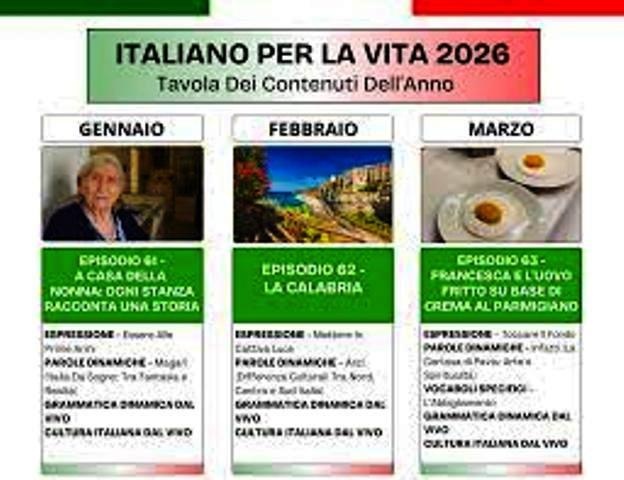 Since I knew we were going to move to Bologna to be near our daughters, and more importantly our grandsons, learning Italian loomed large on the horizon. Having tried Duolingo (if you are wedded to this app, the other Italian language learner in the house informs me that the premium version is worth the fee). I briefly tried a tutor, which proved to be a waste of time in this particular instance and so I turned to the blue void of the internet and looked at over a dozen highly recommended Italian language programs. I finally settled on one called Italiano Per La Vita, created by an enterprising young man from Brescia. It has been a wonderful experience and I continue to use the platform today.
As someone who studied Latin in high school (and ironically it was a subject I learned to love), French and later German – the premise for learning Italian on this platform was a revelation to me. You weren’t supposed to memorize vocabulary and grammar out of context but rather learn it through reading (and watching videos on subjects that you found interesting … and constant repetition in both
Since I knew we were going to move to Bologna to be near our daughters, and more importantly our grandsons, learning Italian loomed large on the horizon. Having tried Duolingo (if you are wedded to this app, the other Italian language learner in the house informs me that the premium version is worth the fee). I briefly tried a tutor, which proved to be a waste of time in this particular instance and so I turned to the blue void of the internet and looked at over a dozen highly recommended Italian language programs. I finally settled on one called Italiano Per La Vita, created by an enterprising young man from Brescia. It has been a wonderful experience and I continue to use the platform today.
As someone who studied Latin in high school (and ironically it was a subject I learned to love), French and later German – the premise for learning Italian on this platform was a revelation to me. You weren’t supposed to memorize vocabulary and grammar out of context but rather learn it through reading (and watching videos on subjects that you found interesting … and constant repetition in both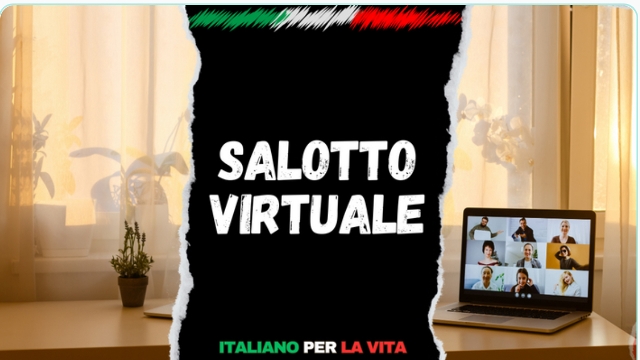 listening and speaking – usually to yourself. Each month this platform provides an engaging module on Italian regions, foods, history as well as ones on grammar and idiomatic expressions, each with an appealing story or conversation. IPLV includes group lessons on Zoom in which you speak in Italian with other struggling students from around the world on a particular topic – politics and religion are excluded. I confess that it took me over a month to screw up my courage to sign up for the first one. There is a book club, and a “Salotto Virtuale” with two 24/7 chat rooms in which students can talk to each other in halting Italian. Sometimes there is only one other person and sometimes there are twenty. But the founder, Alberto Arighini emphasizes that it is important to not stress out over learning Italian merely with lists and out of context lessons, but rather include things that you enjoy watching.
Dolci In Forno
Enter my discovery of Bake Off Italia, which is currently available through Netflix (the one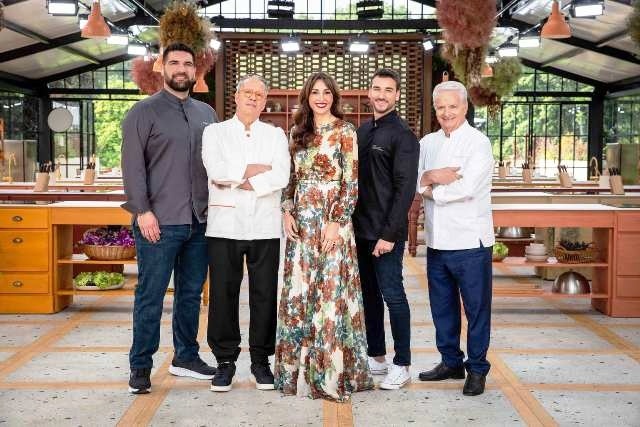 subscription I have hung onto since leaving my homeland) but which may only be available with Engiish subtitles through Apple TV, Globo TV, or using a VPN in the US. Taking the advice of the IPLV team that you will enrich your ability to speak Italian by watching things you enjoy, I am hooked on this version of GBBO. And while this series does not have the intellectual weight of a Fellini film or the poetry of Paolo Pasolini, it certainly has helped me overcome my shyness in trying to speak Italian, enrich my vocabulary and decode this melodious language when it is spoken at warp speed.
Il Tendone
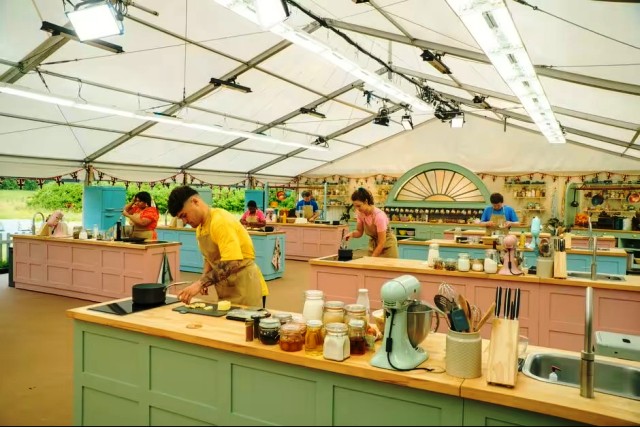 Bake Off Italia is a direct franchise of Love Productions GBBO and had its first run in 2013 – it’s still a steady audience pleaser for Italy’s Real Time free TV channel (ironically owned by Warner Bros) It uses the charming clip and music from the original GBBO series. An Italian villa with its stately garden hosts a similar tent (actually more of a structure with better furniture design than the British version) replete with baking stations. The tendone (big tent) hosts a large number of amateur contestants and three judges while each episode has three similar competitions – Creativa, Tecnica and Sorpresa.
In the first challenge, as in the original GBBO, all contestants interpret a classic dessert using their imagination and personal style. In the technical part, they are given an unknown(to the contestants) recipe chosen by the judges. All desserts are judged “blindly” and often have some complex task within the recipe. The Sorpresa is the Italian equivalent to the British Showstopper and always has an architectural element as well a complex twist on a known dessert. Contestants are eliminated throughout the season and there are always twists and turns in who bakes best throughout the series.
The GBBO successfully offered TV viewers a show in which not professionals, but rather a kaleidescopic selection of “ordinary people” are the contestants. The tempo is not frantic (even though each challenge has a given time constraint) and it showcases not only angst and failure, but mutual support among the competitors, charm and even a sense of kinship and humor. So the bones of the two shows are the same but it ‘s fun spotting the diffeences.
The Italian version to me is even more gentile than its British progenitor. I never found the comedians in the British show to be particularly funny or helpful but perhaps I don’t understand British humor, being from a former colony. And other than Paul Hollywood’s takedown of a particular dessert or his deadly quizzical look when a baker is in the process of creating the required recipe, there is no advice offered. Both Mary Berry and Prue Leith are more benign figures, one in sensible English clothes, the other in delightfully garish outfits. Instead of Kitchenaid Mixers, the Italian one sports the Kenwood. Artificial flowers hang from the tent and peep out of drawers on the baking stations rather than British bunting…Italians seem to like artificial floral and dried flower arrangements a lot.
Italy’s version currently only has male judges; however, culinary journalist Clelia D’Onofrio served as a jude, but now offers a historical context to a particular pastry much in the same way that Prue Leith and Mary Berry did with Paul Hollywood over tea. Rather we see the judges offering advice and admonishment. Ernst Knam, a chocolate maestro born in Germany but owns a Milano destination for chocoholics. Damiano Carrara, a Tuscan pastry chef successfully ran two pastry shops in California and is an enthusiastic participant in several more cutthroat culinary marathons. Tomasso Foglia hails from a Neapolitan family bakery and has achieved stardom in his modernist approach to pastry. And interesting to note, that Bake Off Italia brings in pastry luminaries to inspire the bakers with their choice of a baking challenge. One was Igenio Massari, a gracious and kindly presence to all the competitors. He is a renowned pastry chef with a chain of patisseries and pop-ups throughout Italy. I am working on mastering his crust for Italian crostate which is radically different from both French and Anglo American pie pastry.
Bake Off Italia is a direct franchise of Love Productions GBBO and had its first run in 2013 – it’s still a steady audience pleaser for Italy’s Real Time free TV channel (ironically owned by Warner Bros) It uses the charming clip and music from the original GBBO series. An Italian villa with its stately garden hosts a similar tent (actually more of a structure with better furniture design than the British version) replete with baking stations. The tendone (big tent) hosts a large number of amateur contestants and three judges while each episode has three similar competitions – Creativa, Tecnica and Sorpresa.
In the first challenge, as in the original GBBO, all contestants interpret a classic dessert using their imagination and personal style. In the technical part, they are given an unknown(to the contestants) recipe chosen by the judges. All desserts are judged “blindly” and often have some complex task within the recipe. The Sorpresa is the Italian equivalent to the British Showstopper and always has an architectural element as well a complex twist on a known dessert. Contestants are eliminated throughout the season and there are always twists and turns in who bakes best throughout the series.
The GBBO successfully offered TV viewers a show in which not professionals, but rather a kaleidescopic selection of “ordinary people” are the contestants. The tempo is not frantic (even though each challenge has a given time constraint) and it showcases not only angst and failure, but mutual support among the competitors, charm and even a sense of kinship and humor. So the bones of the two shows are the same but it ‘s fun spotting the diffeences.
The Italian version to me is even more gentile than its British progenitor. I never found the comedians in the British show to be particularly funny or helpful but perhaps I don’t understand British humor, being from a former colony. And other than Paul Hollywood’s takedown of a particular dessert or his deadly quizzical look when a baker is in the process of creating the required recipe, there is no advice offered. Both Mary Berry and Prue Leith are more benign figures, one in sensible English clothes, the other in delightfully garish outfits. Instead of Kitchenaid Mixers, the Italian one sports the Kenwood. Artificial flowers hang from the tent and peep out of drawers on the baking stations rather than British bunting…Italians seem to like artificial floral and dried flower arrangements a lot.
Italy’s version currently only has male judges; however, culinary journalist Clelia D’Onofrio served as a jude, but now offers a historical context to a particular pastry much in the same way that Prue Leith and Mary Berry did with Paul Hollywood over tea. Rather we see the judges offering advice and admonishment. Ernst Knam, a chocolate maestro born in Germany but owns a Milano destination for chocoholics. Damiano Carrara, a Tuscan pastry chef successfully ran two pastry shops in California and is an enthusiastic participant in several more cutthroat culinary marathons. Tomasso Foglia hails from a Neapolitan family bakery and has achieved stardom in his modernist approach to pastry. And interesting to note, that Bake Off Italia brings in pastry luminaries to inspire the bakers with their choice of a baking challenge. One was Igenio Massari, a gracious and kindly presence to all the competitors. He is a renowned pastry chef with a chain of patisseries and pop-ups throughout Italy. I am working on mastering his crust for Italian crostate which is radically different from both French and Anglo American pie pastry.

Recipe
Italian Crostata Shell
Almost a step child of a cake and pie crust, Italian crosata is different from American, British and French and German pastry shells.
Ingredients
- 250gr (1 cup) soft unsalted butter
- 225gr (1 cup + 2tbs) white granulated sugar
- 20gr (2tbs) acacia honey
- 3 gr (pinch) fine sea salt
- 1 vanilla bean
- 45 gr egg yolks ( from 2 or 3 eggs)
- 500gr (4 cups0 00 white flour
- 5gr (2 tsp) powdered cinnamon
Instructions
- In a electric mixer bowl with the flat beater, combine the butter, sugar, honey, cinnamon and the seeds from the whole vanilla ban – slit the vanilla bean lengthwise with a paring knife and then scrape up the pulp with the tip of the knife.
- Beat until you get a homogenous mixture, but not beaten so much that it becomes fluffy
- Mix the egg yolks with the salt (this helps to break up the protein strands in the yolks) and then incoporate them into the mixture, still using the flat beater.
- Slowly add the flour in small amounts while the flat beater is on slow speed on until that too is fully incorporated.
- Divide the dough into two 450gr u0022pattiesu0022 and wrap them in parchment paper.
- At this point you can freeze them or roll one out as the base and the other as a decorative edge and strips.
- It can also be piped out decoratively around the edge of the crust and as a more polished looking lattice.
Notes
- You can prebake the base shell blind and then add a filling for further baking, add your lattice strips or pipe a lattice for the final bake.
Comments & Reviews