
Macedonia: Not a Recipe, But a Procedure
 My introduction to the deliciousness of the Italian macedonia, enlivened with a generous dash of liquore, came at the tender age of five or six. Our family, stationed in Germany after World War II, often vacationed in northern Italy. I believe we were in Sirmione, at a nice hotel where children were allowed to eat dinner earlier in the dining room without their parents. Dinner was a set menu, and my older brother and I were seated at a large round table by ourselves. I don’t remember anything about the appetizer or the main course, but I do remember my brother turning up his nose at his portion of mixed fruit salad for dessert. I, however, mysteriously loved it, especially the tantalizing sweet bite from the alcohol. I may have eaten his too.
We returned to our room and our parents went down to dinner. While my brother and I were gearing up for our battle over the dividing line of the large bed we had to share—we would kick each other if one of our limbs crept across the border—my parents burst into the room to see if we had become inebriated from the brandy-soaked macedonia. We briefly stopped our internecine fighting to reassure them we were fine.
I have discovered since then that there is a real difference between insalata di frutta and macedonia. The first is never dressed, while the latter is always macerated with at least lemon juice and sugar, if not something a bit stronger. And of course, Italy celebrates on June 6: La Giornata della Macedonia.
To Each Their Own
While the RWM revels in his colazione americana of two fried eggs, two strips of bacon, and toast 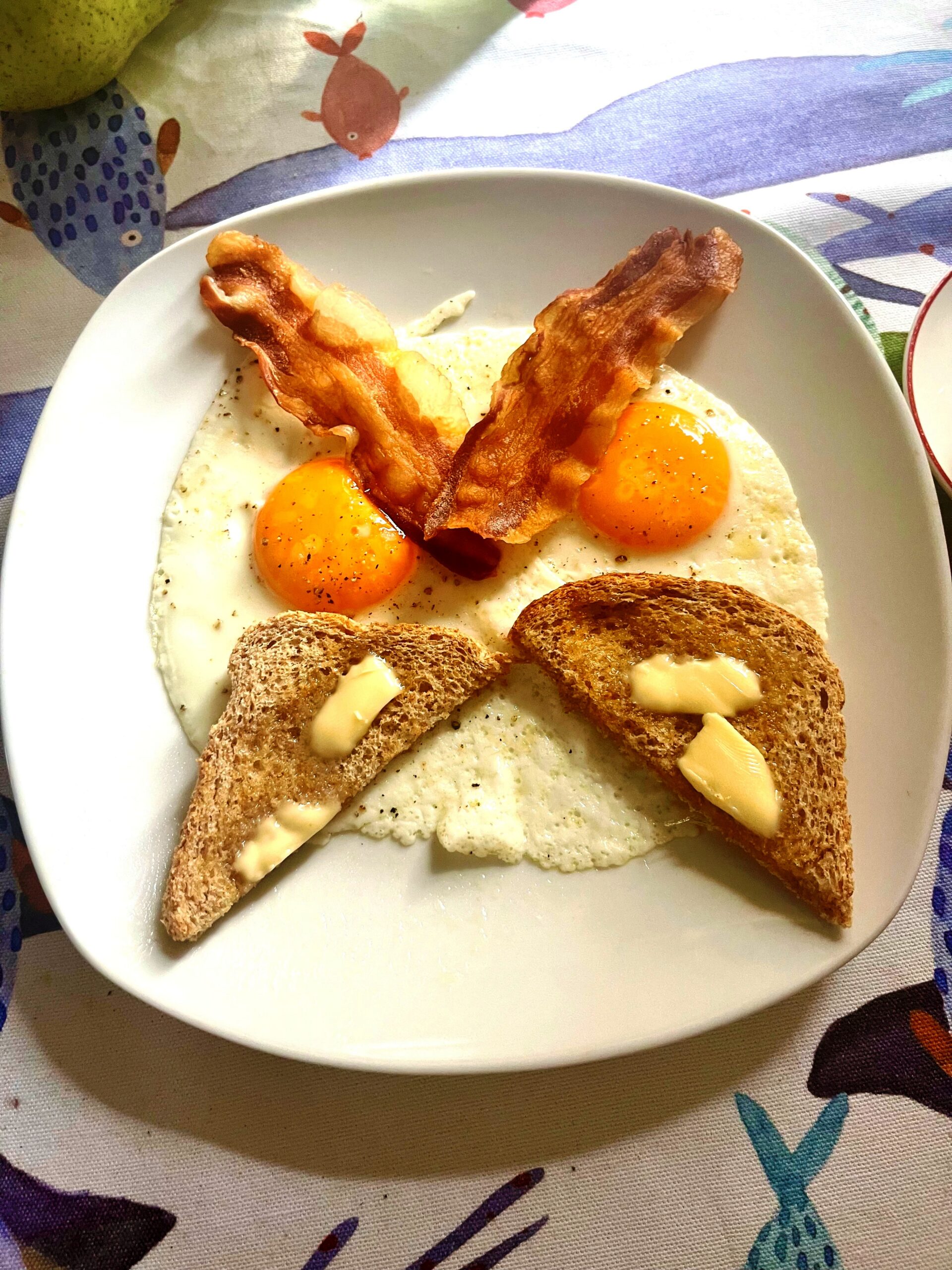 made from Pane Finto (fake bread) with hard-to-find salted butter, I fix a macedonia, always with a dash of Triple Sec. While perhaps neither of our choices is the breakfast of champions, my version of this Italian classic has become a favorite with my daughter’s Italian friends when she creates an American-style brunch.
The history behind the name, so much more sophisticated-sounding than “fruit salad,” is somewhat murky. One theory is that it is a culinary metaphor for the mixed ethnicity of either Alexander the Great’s empire (which lasted only twelve years, 336–323 BC) or the Ottoman Empire, one that endured for more than six centuries (1299–1922). In both empires there was a mixture of diverse populations in the region known as Macedonia—Greeks, Albanians, Bulgarians, and Turks. According to Wikipedia, my favorite fount of knowledge, it appeared in 18th-century French cookbooks as macedoine to describe a mixture of vegetables or fruits, and also as a word for a jumble of unrelated elements. It later appeared in a Piemontese cookbook around 1815 and then in the first 1891 edition of Artusi’s famous La Scienza in Cucina e l’Arte di Mangiar Bene, where it had the charming title La Signora Macedonia and was served freezing cold!
 When La Cuisine was open, we used to receive huge boxes of Italian and Australian candied and dried fruit, which we’d break down into more manageable portions for our customers. These were particularly popular at Christmas and Easter. Vanini and Agrimontana were our top suppliers. That’s when I started folding them into my version of macedonia. And as my Italian son-in-law always says, it’s not a recipe; it’s a procedure. What follows are the principles.
The Procedure
Start with whole fresh fruit. The canned fruit cocktail served at buffets, cafeterias, and on your hospital tray is just too sad and uniformly mushy. Fresh fruit gives you both diverse textures and tastes. Cut fruits (except 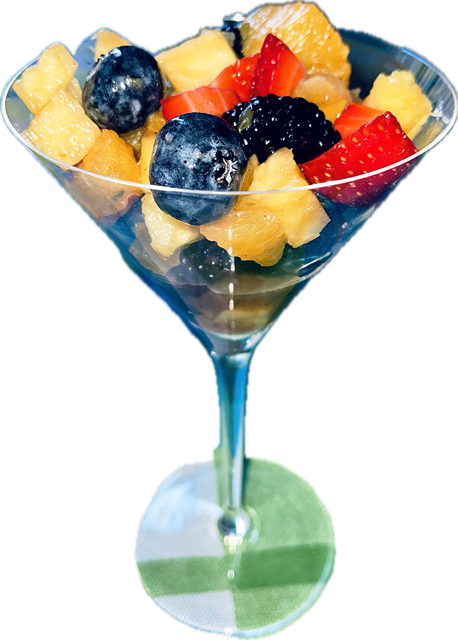 small berries) into approximately 1 cm or 1/2-inch pieces. Most store-bought fruit mixes fail here: the pieces are too large and usually underripe.
Build your base, then add seasonally. Pineapple, available year-round almost anywhere, makes an ideal foundation. Whack off the stem, slice at least a one-inch ring, cut the pieces away from the core, and cut into small dice. From there, let the season guide you whenever possible.
In winter, add orange segments, each cut into two or three pieces. Pears, apples, and kiwi—Italy has become a major producer of both golden and green—are lovely additions. I’ve tried red currants, but my audience consistently votes for out-of-season strawberries, blackberries, blueberries, and raspberries, which are grown surprisingly successfully in Sicily and Spain. One note on apples and pears: toss them in a little lemon juice right after cutting to keep them from browning.
In summer, drop the citrus and add peaches and nectarines—both yellow and white, whatever looks best, but always diced small. Halve your grapes and remove seeds if necessary. Plums are possible but don’t integrate as happily. Melon works well in summer and early fall. I skip bananas entirely; it’s my one fruit aversion.
Add the dried and candied fruit… this is the secret. A small amount of good dried and candied fruit, cut into fine dice, is what lifts this from pleasant to memorable. Dried apricots are easy to find; otherwise, chopped prunes or whole sultanas work. Avoid dried apples and pears, as the ones I have found were too leathery. Fresh cherries, halved and pitted, are lovely; candied cherries, oddly, are not.
Candied ginger is a must—just a small amount. Add at least half a ring of candied pineapple, finely diced. Candied mango or papaya in fine dice is excellent. You only need a tablespoon or two of each. At the very end, tear in a mint leaf or two and mix thoroughly—add it too early and it loses its brightness.
Dress it. This is where the magic happens. A tablespoon or two of Triple Sec is preferable to Cointreau for this purpose, being a touch less alcoholic and sweeter on the orange. This liqueur takes the whole thing to a spectacular level. If you’d rather skip the alcohol, warm a small amount of good-quality fruit jam with an equal amount of water until smooth and stir that in instead. The classic non-alcoholic approach in Italy is superfine sugar dissolved in fresh lemon juice. Start with the juice of half a lemon and a tablespoon of sugar, then adjust to taste.
Let the macedonia sit for at least fifteen minutes before serving, as the macerating time lets the flavors meld. It serves four to six generously as a dessert or brunch dish. You can make it a few hours ahead, but by the next day it looks a bit tired and loses some of its sparkle. Made fresh, though, following these principles? Sensational.
Comments & Reviews