Read Time: 7 Minutes Subscribe & Share
Holiday Preamble:
This post reflects my annual Christmas desire from my retail days to just lie on a couch with some leftover Christmas treat (and a cocktail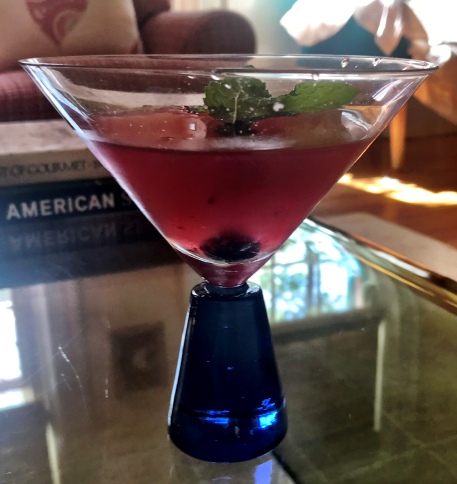 ) while I read and ponder in peace during my sacred week of relaxation. If you need some help, here is the link to last year’s post on this very subject.There is lots to unpack in this year’stopic, but it is such a light and fluffy one, plus the characters involved blessedly are not from our shores.
Who knew that a UNESCO title of Intangible Cultural Heritage for Italian Cuisine would become a topic of international gossip and snark? Am I the only one who had no idea that there was even such an award for something so ephemeral as intangible cultural heritage? I have read several articles online, celebratory photos are streaming on my IG feed, and I’ve listened to some fairly heated discussions. Obviously we need to know more.
Long Live Intangible
This recognition reflects an effort by UNESCO (the UN agency founded to develop peace through science, education and culture) to expand civilization’s achievements and history beyond monuments – the Egyptian pyramids for example – or groups of cultural artifacts such as the collections in New York’s Metropolitan Museum. A different tangible cultural history example would be the multiplicity of Scottish tartans, which continue to be worn by the clans in their homeland, but are also proudly displayed by their immigrant descendants in such far-flung places as my former home, Alexandria, Virginia…along with the somewhat intangible sound of bagpipes on holidays!
Intangible Cultural Rules
UNESCO wanted to identify and honor cultural traditions, like the playing of bagpipes, which are routinely practiced in either distinct communities or nations, some are unique to a particular region and others have traveled and evolved with immigration. In 2003 the organization created five very broad intangible cultural heritage categories:
- Oral traditions and expressions, including language
- Performing arts
- Social practices, rituals and festive events
- Knowledge and practices concerning nature and the universe
- Traditional craftsmanship;
France successfully submitted the first intangible cultural history entry related to its cuisine in 2010, for its tradition of the French Gastronomic Meal, which they described as a
traditional social practice which features prominently in important celebrations including weddings, anniversaries, and birthdays. The festive meal gathers people together to enjoy good food and drinks. It seeks to foster togetherness and appreciation of taste and products of nature. The meal commences with an apéritif, which is a drink before the meal, and after four successive courses consisting of a starter, meat with vegetables, cheese, and dessert, and ends with liqueurs. The meal emphasizes on the careful selection of dishes, buying of goods which are mainly local, the pairing of food with good wine, and the beautiful arrangement of the table.
France’s success in having its gastronomy entered in this vague category has been criticized as a nefearious project by disgraced former president Sarkozy (who is currently serving at-home prison time) in which an elitist meal (rather than everyday French cooking) was given preference over cuisines – in paarticular, Italian cuisine – which claim to have a longer, more storied history than the French. Several very high end restaurant chefs such as Paul Bocuse and Joel Robuchon backed this particular approach rather than the more accessible aspects of French cuisine. Below is their video for their winning submission.
Japan submitted its tradition of Washoku as a winning entry in 2013, which celebrates
the social practice based on a set of skills, knowledge, practice and traditions related to the production, processing, preparation and consumption of food. It is associated with an essential spirit of respect for nature that is closely related to the sustainable use of natural resources. The basic knowledge and the social and cultural characteristics associated with Washoku are typically seen during New Year celebrations. The Japanese make various preparations to welcome the deities of the incoming year, pounding rice cakes and preparing special meals and beautifully decorated dishes using fresh ingredients, each of which has a symbolic meaning.
This entry was also criticized as a heavy handed show of gastrodiplomacy by the Japanese government, amidst scandals of food mislabeling and claims of inauthenticity. Below is the video the Japanese government produced to accompany their documents to support Washoku as an intangible cultural history practice worthy of inclusion in this UNESCO category.
This year, Italy’s current government submitted its regional cuisines as a whole entity that promotes biodiversity, sustainability and inclusion. Below is their successful submission along with their video.
A cultural and social blend of culinary traditions, the element is associated with the use of raw materials and artisanal food preparation techniques. It is a communal activity that emphasizes intimacy with food, respect for ingredients, and shared moments around the table. The practice is rooted in anti-waste recipes and the transmission of flavours, skills and memories across generations. It is a means of connecting with family and the community, whether at home, in schools, or through festivals, ceremonies and social gatherings.
People of all ages and genders participate, exchanging recipes, suggestions and stories, with grandparents often passing down traditional dishes to their grandchildren. The knowledge and skills related to the element are transmitted both informally within families and formally in schools and universities. Beyond cooking, practitioners view the element as a way of caring for oneself and others, expressing love and rediscovering one’s cultural roots. It gives communities an outlet to share their history and describe the world around them. It also helps safeguard specific cultural expressions, such as language and gestures. The practice thus fosters social inclusion while promoting well-being and offering a channel for lifelong, intergenerational learning. It also strengthens bonds, encourages sharing, and promotes a sense of belonging.
The submission was in part developed by a food historian and professor of medieval history, Massimo Montanari at the University of Bologna, along with the Academy of Italian Cuisine and food magazine Cucina Italiana. While there is certainly room for the usual criticism as to how this submission was developed, perhaps the most divisive sticking points are efforts by the Minister of Agriculture, Francesco Lollobrigida, and the Fascist-Lite government headed by Giorgia Melloni. And yes, Francesco is the grand nephew of Gina Lollobrigida and was the longtime domestic partner of the Prime Minister’s sister.
You should be aware that he was a founding member of the right wing party currently in power. A noted anti-immigrant politician, Lollobrigida is famous for his replacement theory comments on the low Italian birth rate and high immigration. A particularly galling gaffe was his rearranging a standard train schedule so he would not be late for a meeting. Expertise in Italian agriculture does not appear on his résumé, but he has close ties with the industrial agricultural lobbying group Coldiretti. He successfully engineered the ban on lab grown meat in Italy and has aligned his department with the Italian movement to litigate “Italian Sounding” foods marketed by foreign entities. Think Wisconsin Parmesan and Prego pasta sauces from Campbell Soup Company. While I think that going after Chef Boyardee may be a bit like the travails of Don Quixote, I do applaud the ban on synthetic beef.
France was accused of using “gastrodiplomacy” to present itself as a superior nation rather than exhibiting a particular cultural tradition. Japan’s subsequent entry tries to use the “gastronomic meal” approach of France in to what critics viewed as a cumbersome and not truthful portrayal of the tenets of this New Year’s meal. Italy’s submission certainly took its cue from the TV series “The Chef’s Table” so that it looks like a slickly curated exhibition in a museum video.
I must say that this type of food fight appeals to me. I was trained in French cooking but came to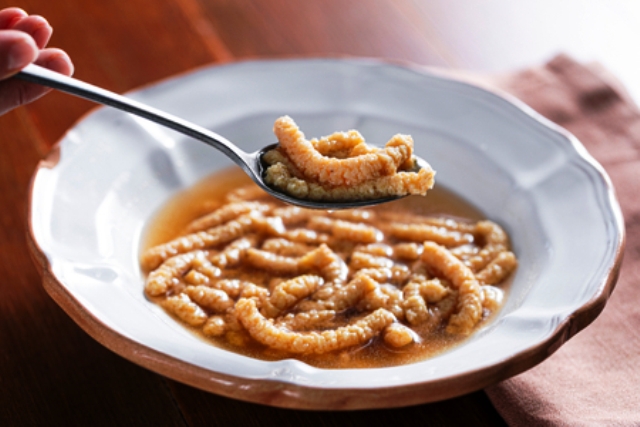 appreciate Italian regional dishes for their use of what was on hand and their ability to let vegetables be vegetables. And passatelli has to be the most imaginative way to use bread crumbs. My only acquaintance with Japanese food is when we go out for sushi (wildly popular in both the US and Italy) although I certainly use miso and soy sauce at home. In the end though, there is something to be said for brandishing your dishes before the world instead of your weapons.
By submitting this form, you are consenting to receive marketing emails from: Kitchen Detail, Via de'Falegnami 5, Bologna, 40121, http://www.lacuisineus.com. You can revoke your consent to receive emails at any time by using the SafeUnsubscribe® link, found at the bottom of every email. Emails are serviced by Constant Contact

Kitchen Detail shares under the radar recipes, explores the art of cooking, the stories behind food, and the tools that bring it all together, while uncovering the social, political, and environmental truths that shape our culinary world.




A delightful read for the holidays. Bravissimo!
Ciao David!
Actually, the Unesco Intangible Culture recognition websiste has some fascinating “awards” – the swimming pool culture in Iceland, tightrope walking in Korea and manual bell wringing in Spain, just to whet your appetite for further reading and viewing!