News to Me
When I first moved to Bologna, a new-to-me English phrase came up in food-centered conversations: Italian sounding. I was totally mystified, as I had never encountered this phrase in food blogs, videos, or the news while living in the United States. Here I must add that most of my online reading is centered around food, with occasional forays into ballet film clips.
It’s somewhat of a hot topic here, though, in Slow Food circles, forums for food writers and presenters, corporate food entities, and even among some politicians, such as the current right-wing Minister of Agriculture, Franco Lollobrigida. I even found, and promptly followed, an Italian American, Robert Campana, who runs a very engaging Instagram account appropriately called “Stop Italian Sounding.”
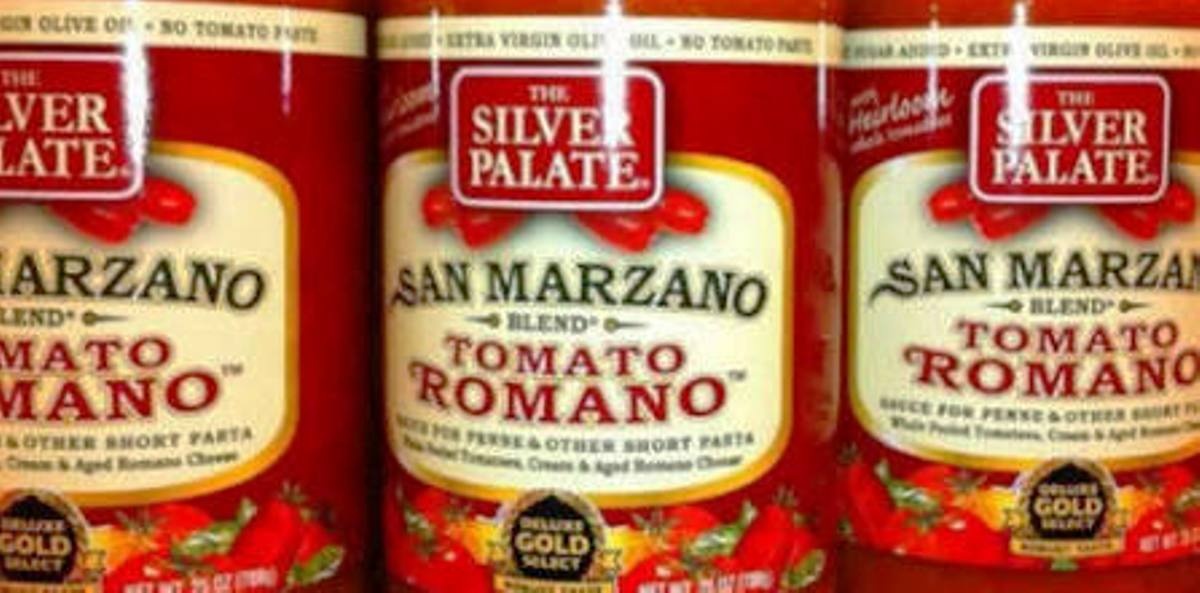
The roots of Italian sounding obviously developed alongside the huge 19th- and 20th-century waves of Italian immigration to North and South America. Consumer demand grew without the means to fulfill it with true Italian products. Very little was exported from Italy to the New World. To meet that demand, domestic producers, as well as businesses founded by Italian immigrants, reinvented similar foods and slapped on Italian names, Italian map outlines, flag colors, and even comically Italian-sounding names. Chef Boyardee comes to mind.
Egregious Italian sounding
Personally, I remember both my mother and my mother-in-law pulling out their plastic-topped glass 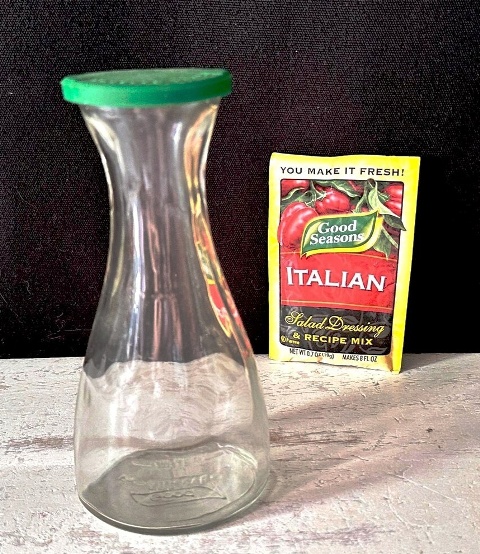 cruets from Good Seasons, along with the accompanying packet of Italian dressing mix. Following the markers etched on the bottle, you added vinegar and usually “salad oil” — not olive oil — followed by the mysterious packet of Italian seasonings. After adding them to the bottle, you shook it vigorously and, voilà, Italian dressing.
Good Seasons is a brand of Kraft Heinz and has been an American staple since its invention in 1952. While the ingredients in this “Italian dressing” include soy sauce, dried carrot, bell pepper, and parsley flakes enhanced by guar gum, its principal ingredients are sugar, followed closely by salt. In Italy, you are handed cruets of olive oil and wine vinegar, usually a balsamic derivative, along with salt and pepper to add to your salad as you wish.
But there are many other examples. Our Prego pasta sauces and Parmesan versions of Parmigiano-Reggiano cheese are two other howlers. But fear not: we are not alone, as Brazil produces a cheese called Parmesao. To be fair, the Sartori family from the Po Valley did immigrate to Wisconsin and, as part of that state’s dairy boom, developed one of the leading brands of Parmigiano spinoffs.
The complaint is that Parmesan is nothing like Parmigiano-Reggiano cheese. I remember buying several brands of Parmesan cheese that were pleasantly salty in taste and cakey in texture, and aging was not part of the marketing. It did not have the buttery, nutty flavor of Parmigiano, which has to be aged at least 12 months. You can have tastings of it at 36 months and even 72 months, and the tastes and textures of this cheese at different stages are pleasing to discern.
And it’s not just the US. There are pseudo-Italian foods manufactured and marketed elsewhere: Germany has Cambozola, a bland parody of Camembert and Gorgonzola; France produces and markets Jambon de Parme, a domestic copy of Emilia-Romagna’s prosciutto crudo. Even the Dutch, who have no problem producing food 24/7, have a line of sauces under the brand “Spagheroni.” China has products labeled “Toskany” that are, of course, produced by small companies in China and do not come close to meeting the requirements of the originally named Italian food.
All of this Italian misalignment comes at a cost to Italian food producers, who have to follow meticulous procedures to call their product Mozzarella di Bufala or Aceto Balsamico, with the additional guarantee of excellence. Italian sounding advocates estimate that several billion in Euros are lost annually to these falsely branded foods, which trade on Italian culinary traditions and regional excellence. For foods protected in the EU under DOP, IGP, and STG regulations, the value of authentic products in foreign markets is diminished by millions of euros.
Defining excellence
These initials are not just pretty-sounding acronyms. DOP stands for Denominazione d’Origine Protetta, or Protected Designation of Origin. This means that not only the packaging, but more importantly the production and processing of a certain food, must follow rigorous standards. The DOP classification guarantees that the food comes from a particular area where the agricultural tradition was established. Prosciutto di Parma and Prosciutto di San Daniele are examples, and they differ in flavor.
IGP, or Indicazione Geografica Protetta (Protected Geographical Indication), is a little fuzzier around the borders. When you see it on a label, it means that the qualit is linked to a specific region and its traditional production of that food. More importantly, it guarantees that at least one part of its production or packaging must be carried out in the designated area. Aceto Balsamico di Modena or a specifically marked Tuscan olive oil are frequently given as examples.
Occasionally you will see the term STG, which is the loosest category but still has validity. Specialità Tradizionale Garantita does not guarantee that a product is from a specific region, but rather that its producer followed a traditional recipe or production method. There are lots of tasty STG dmozzarella cheeses, for example, and certainly producers of STG Neapolitan pizzas. To have that attached to your label, you must guarantee that you are following the traditional production guidelines.
Walking the Walk
And now the largest agricultural union in Italy, and actually in the EU, Coldiretti — Confederazione Nazionale Coltivatori Diretti — is using its formidable clout to expose fraudulent products in the press and on social media. It is pushing EU members to crack down on the use of Italian names and phrases on products produced outside Italy’s borders.
It has even reached the giant US Fancy Food Show, which I used to attend religiously, with displays of authentic Italian products and their “Italian Sounding” counterparts. It is also slowly lobbying other 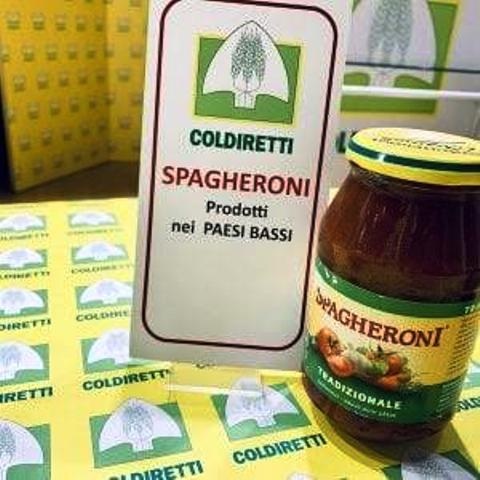 countries to tighten their laws about what is allowed on a label. Within Italy itself, Coldiretti is working with agricultural producers, including small farmers, to market themselves better and to demand tighter food regulations. Barcodes are already appearing that include a product’s Italian authenticity. A shopper can use the Authentico app to unlock the code.
With respect to the lost income — and we are talking millions, if not a couple of billion, euros or dollars in lost revenue — Italian sounding battles are not going to be easily won. It’s not just the US and its Prego sauces, but also other EU countries and international markets that are not going to give up their profitable, if cheap, copies of Italy’s enviable food culture.

Comments & Reviews