
In Memoriam
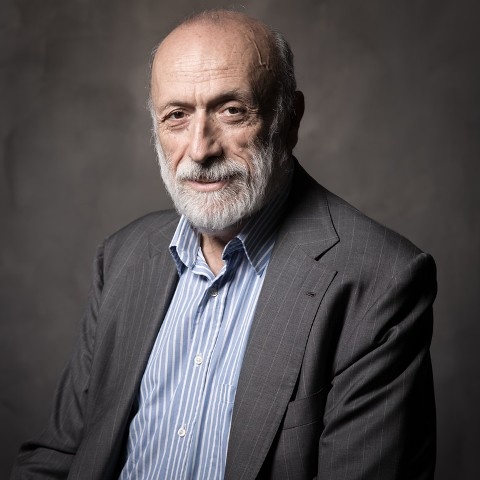 Carlo Petrini died last week. On March 21, to be exact, in his hometown of Bra, from prostate cancer at the age of 76. A passionate writer and thinker, he personified a more academic, archival opposition to the industrialization of what the world eats. An Italian citizen whose roots were firmly planted in a country where regionality is revered, he was the perfect man for the job of sounding the alarm over loudly emblazoned cardboard containers of indistinguishable fried potatoes and hamburgers. The Slow Food movement Petrini spawned has evolved quietly over the last three decades, without a lot of noisy fanfare in the press or on social media. But I was surprised at how many projects it has birthed and sustained. And this from a man who launched an upstart movement as a social club for like-minded progressive thinkers. Rather than focus groups and think tanks, Carlo Petrini sought the protection and promotion of locally sourced foods and sustainability, along with the exchange of ideas over a glass of wine, albeit slowly.
Meet Me on the Spanish Steps
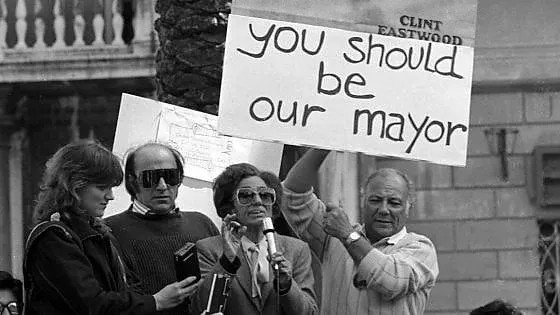 This articulate and creative journalist brought the complex issues of food production into focus in unusual ways. When McDonald’s was going to open its largest restaurant on the Spanish Steps in Rome (and they succeeded; it is still there with seats for 450 unfortunate people), Carlo Petrini organized a very different protest. Rather than simply bearing the expected signs and loudspeakers, the protesters passed out plates of penne pasta with a mantra of “We don’t want fast food, we want slow food.” A humorous footnote is the sign shown in this photo at the demonstration: Clint Eastwood had become mayor of Carmel-by-the-Sea in California and had cracked down on fast food franchises.
Petrini and his group of kindred thinkers formed a club with the title of Arcigola, a clever combination of the ARCI (Associazione Ricreativa e Culturale Italiana) and the Italian word gola, which means gluttony. The ARCI itself was a loose association of left-wing social clubs that supported a variety of grassroots political concerns. This “club,” however, grew beyond its original intent of promoting locally grown foods and culinary traditions, along with the pleasure of progressive change being fostered over shared meals. A group of Arcigola members from 15 countries met in Paris in 1989 and signed a founding “manifesto” that today is the backbone of Slow Food International.
Today, with its snail logo (chiocciola), Slow Food International has created an incredible number of initiatives, associations, educational programs, and guides. These are not loud protests, so they result in few headlines or social media memes flashed on our phones. But the breadth of Petrini’s ideas has a worldwide reach. Below are just some examples and links.
Turin has hosted Slow Food’s Salone del Gusto every two years since 1996; under the Terra Madre arm of Slow Food, it will take place in September of this year, the largest international agricultural fair in the world, featuring producers, culinary tastings, and food policy workshops. For more information on this remarkable event, click on Salone del Gusto.
Along with the establishment of the Salone del Gusto under Terra Madre, you can explore the Ark of Taste and its guide to indigenous and regional foods in each country. I was surprised to see we have 401 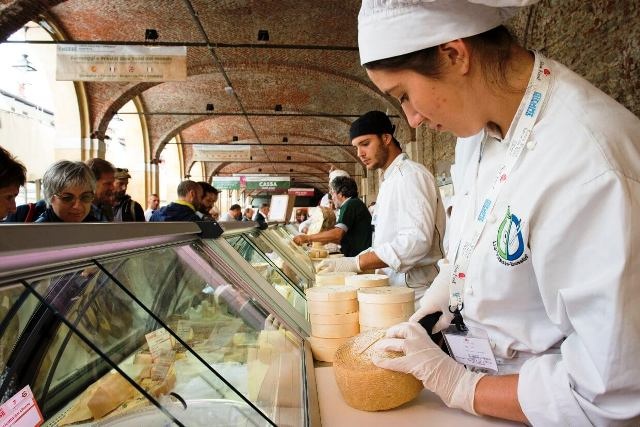 guides registered from the US. Since 1997, Slow Food has hosted a Cheese Event in Bra, Italy, in odd-numbered years. The last one was in 2025, and the next one is planned for 2027. I think this is one area where US producers have truly excelled. I love cheese and applaud the idea of a cheese course at dinner, with a nod to this wonderful French tradition.
As an extension of its Ark of Taste, Slow Food established Presidia in 1999, which is really a platform where small farmers and producers around the globe can learn protocols, share information, and find access to markets.
One of the most ambitious projects that Carlo Petrini and his associates undertook was the University of Gastronomic Sciences in Bra. It is housed in the recycled 19th-century estate of King Carlo Alberto of Savoy. With only 60 students in 2004, it has grown to over 2,400 students this past year, many from other countries. It offers undergraduate degrees as well as master’s and doctorate programs. Students mix studies of biodiversity and food politics with hands-on training in specific farming and food production techniques. Its courses offer field trips to work with food artisans and farmers outside of Italy as well. American graduates have used their degrees in piloting programs in food waste mitigation, building new agro-communities (Hudson Valley in New York is a notable example), and training farmers in regenerative agriculture.
On a personal note, Carlo Petrini’s accomplishments have sparked my curiosity about the Slow Food initiatives in my adopted city of Bologna. There are three small Slow Food producer markets, one in the city center and two others in outlying areas, emphasizing no packaging and less spoilage, as the produce is fresher than what is shipped to grocery store chains. The Bologna chapter, in addition to supporting local producers, has waded into the food waste battle, and this city, with its university-backed research, has become a national inspiration in food waste management. I also discovered that a marvelous bakery near me on Via Galliera was founded by graduates of his University of Gastronomic Sciences. Do visit Forno Brisa should you come to Bologna.
But perhaps one of the sweetest moments was looking up the Slow Food Guide (yes, this was a dream of Carlo Petrini, a retort to TripAdvisor) and finding two of my favorite restaurants, where we dine for lunch or dinner several times a month, Caminetto D’Oro and Twinside, prominently featured as stellar Slow Food beacons. Bologna is helping to cement Petrini’s slow food legacy — even without Clint Eastwood’s help.

Comments & Reviews