Amber Waves of Grain
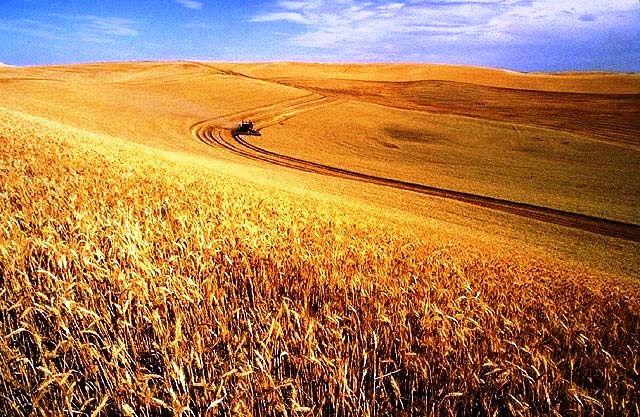 Ever since elementary school, when our class would sing “America the Beautiful,” my favorite line from Katherine Lee Bates’s lyrics has been “For amber waves of grain.” Bates originally titled her poem “Pikes Peak,” and it was later set to music by Samuel Ward—who, like Bates, had written his piece for an entirely different purpose. The two never met. Even so, the pairing felt inevitable to my fifth-grade self, who could easily picture those endless Midwest wheat fields thanks to our obligatory study of American geography and history. That image of rippling grain was further fixed in my imagination by the grainy (hah!) films we watched in the school auditorium—celebrations of American agricultural might, and its power to feed not only our own nation but also millions of hungry people around the world.
Obviously, in my later adulthood, I am a bit more skeptical about the perfection of our waves of grain, amber and otherwise, and have doubts about our ability to feed ourselves, much less anybody else. But I was surprised to read about the real agricultural powerhouse of our planet: the Netherlands.
A Search for Solutions
This is a country smaller than the state of West Virginia, and it suffered severe starvation during the latter part of World War II. At least 20,000 Dutch citizens died during this period, as the Allies struggled to regain control of the Netherlands through their military campaign—aptly called “Market Garden.” Audrey Hepburn, who suffered lifelong medical repercussions, was a survivor of the Dutch Hongerwinter. Although, after the war, the Dutch government certainly focused on the nation’s food production, it was not until 2000 that a major shift in administrative resources, university research, and business acumen was harnessed to produce the incredible results we see today.
Watch video: Dutch agriculture overview
You Say Tomato
Take tomatoes: You see them perched along green stems in your grocery store—Dutch 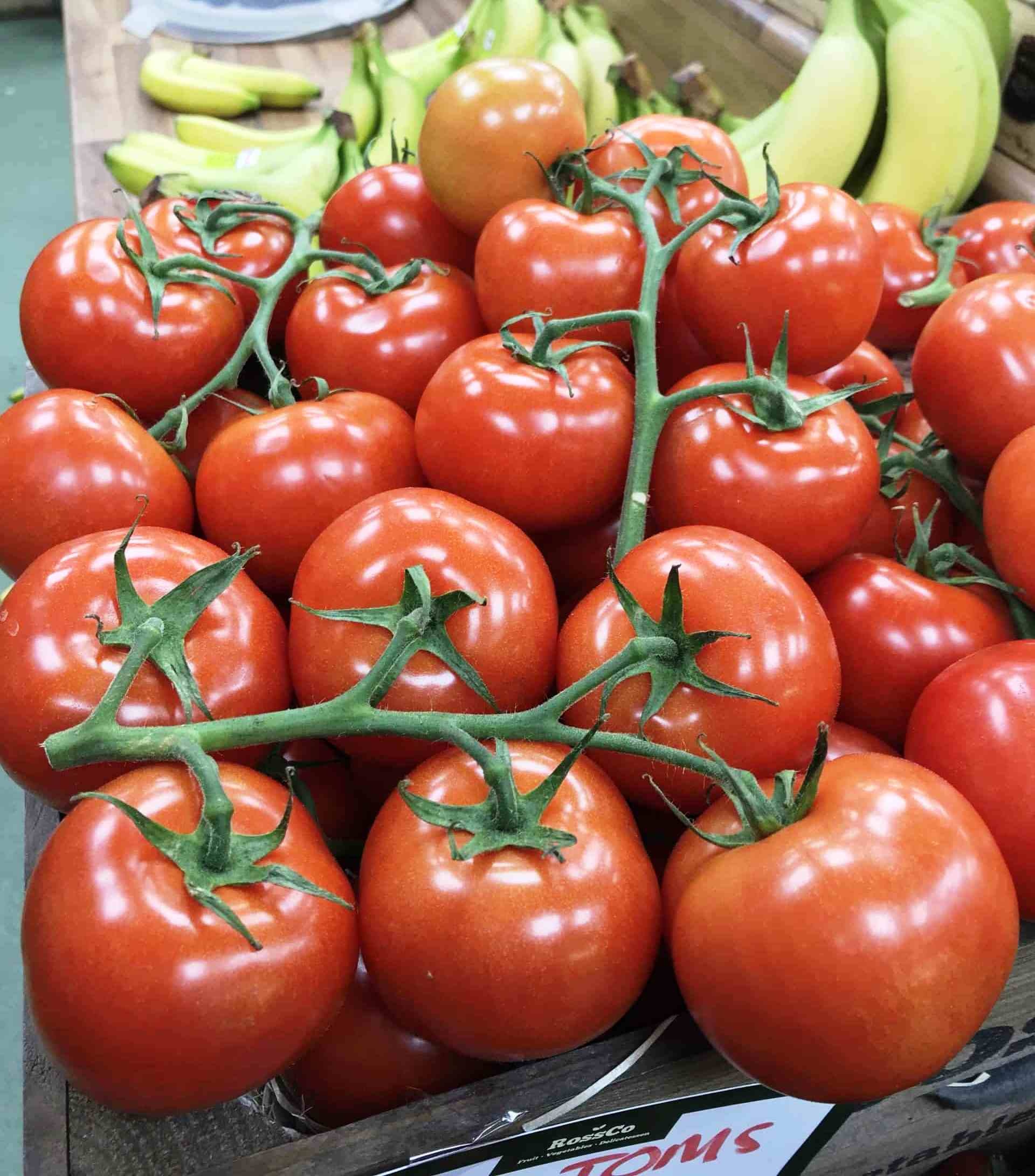 tomatoes, which in winter look so inviting and even have a whiff of tomato perfume. Holland grows and exports more of them than either Spain or Italy. Ditto Dutch potatoes and onions. While China produces the most tomatoes by tonnage, its yields are actually low for the amount of land and water used. The Netherlands outstrips every other country in tomato production by far—over 14,000 tons per square mile (we are ranked third in terms of production per square mile).
A Middle Class Was Key
This patch of land, forever wrestling territory from the sea, laid the groundwork for its 21st-century agricultural revolution several centuries ago. Even the shock of famine during World War II served only to steel the Dutch government’s resolve to foster the kind of innovation that still staggers the imagination today. It’s all the more remarkable given how densely urbanized the country already was. The seeds of that transformation, though, were planted much earlier.
By the 17th century, the Low Countries had built a thriving urban middle class. Amsterdam alone grew from 30,000 to 200,000 people, and feeding this surging population demanded new thinking about the land. Out of that pressure came a sophisticated four-crop rotation system that swept away the old medieval practice of leaving fields fallow to recover. In its place, each plot of land was put to purposeful work year-round—wheat the first year for bread, turnips the second to enrich the soil and feed cattle, barley the third for beer, and grasses the fourth to restore the earth and sustain livestock once more.
Reclaiming farmland from the sea with canal and dyke systems also strengthened Dutch engineering knowledge, which spread to England, where Dutch expertise helped the agricultural revolution flourish and increase the size of the middle class. This, in turn, contributed in both countries to social and political evolution that was lacking in lands that continued to rely on a two-tier landowner-and-serf system.
Twice with Half
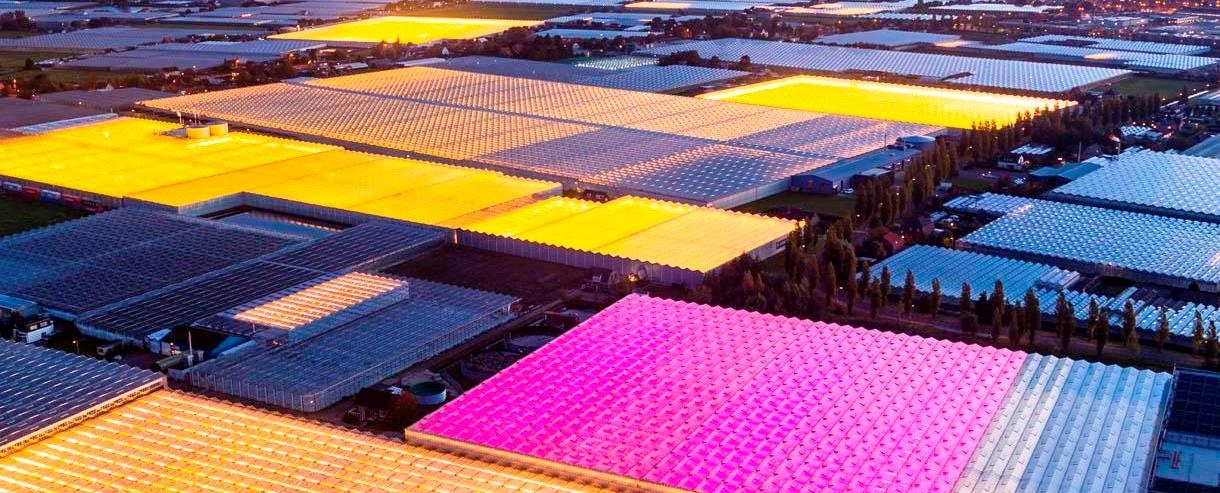
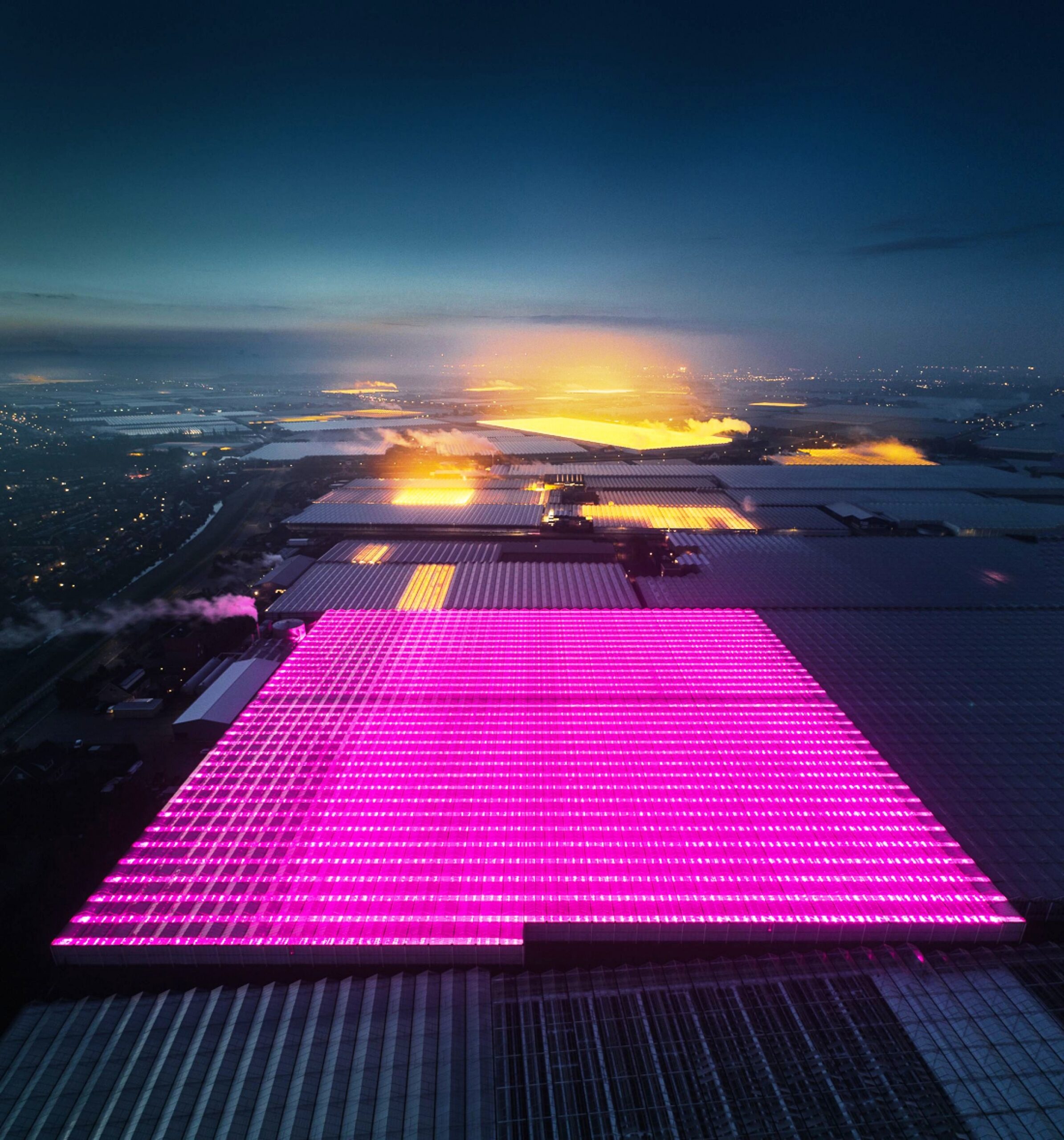 It was not, however, until the dawn of this century that the Dutch government took steps to implement its almost otherworldly approach to, in their own words, “produce twice as much food using half as many resources.” Reading the room scientifically, they have worked with forecasts of climate change, population growth, and the limits of land productivity. Through research and funding, the Dutch have excelled in vertical farming, LED technology, and water efficiency. At night, vast greenhouses—some covering almost 200 acres—light up the sky. Fields are monitored by drones, robotics are used extensively in cultivation, and artificial intelligence is used to improve sustainability and efficiency, with the result that harmful pesticide and antibiotic use has diminished substantially, and precious salt-free water is used more productively.
The center of this Food Valley, often compared to Silicon Valley, is Wageningen University, which has become a world leader in farming technology. There are echoes of Stanford University as the nucleus of California’s famous tech valley. Surrounding this university are dozens of experimental farms and start-ups dedicated to advancing agriculture. Not to be missed is Dutch seed innovation produced by Seed Valley in North Holland. This has also helped the Netherlands become a global leader in the export of seeds for fruits, vegetables, and flowers.
Innovation Problems
Intensive farming has produced environmental and labor headaches similar to those in the U.S. Downsizing farming has actually become a hot issue. Not surprisingly, the Dutch historically became masters of selective breeding in farm animals, particularly cattle and poultry. Over centuries, cattle were bred to produce more milk and meat, so that today Holstein-Friesian descendants are globally among the most prolific breeds. And naturally, in time, cheese became yet another Dutch export strength. But the expansion of livestock for food is a serious problem. Nitrogen runoff, animal waste disposal, and living conditions before slaughter have again been addressed with innovations that transform waste into animal feed, heat, and environmentally friendly fertilizer.
This final video shows how Dutch research has addressed the issues of humane treatment of livestock and environmentally sound innovations for mass food production. Even small chicken comforts, such as dust baths and scratch-and-peck areas, are engineered into poultry housing. Their solutions to large-scale poultry farming, funded by both the Dutch government and the industry itself, should be a lesson to livestock giants such as Cargill, National Beef, Tyson in the U.S., and JBS in Brazil.
Watch video: Dutch livestock and poultry innovation
What the Dutch have accomplished surprised me. I look at my grocery choices differently as I shop at two huge grocery store chains. I still love buying local and organic and revel in what Mercato Delle Erbe and Mercato Ritrovato have to offer. Near me is a butcher whose selection is limited but excellent, a local farm cooperative around the corner that simply sells what they grow throughout the year, and a bakery that prides itself on using healthy grains—great for bread, cookies not so much. These are luxuries I feel privileged to have. Feeding a planet of eight billion people, on shrinking arable land, with a climate that grows less predictable by the season, is arguably the defining challenge of this century. I look at how the U.S. is still fumbling toward that reckoning. One small, waterlogged country, shaped by centuries of necessity and loss, has been doing the hard thinking for the rest of us.

Comments & Reviews