Getting to Know You
 We heap accolades on the likes of José Andrés, first for his determined showcasing of Spanish cuisine and its colonial derivatives against the tsunami of French and Italian restaurants, and then for his continuing efforts to feed the disadvantaged — whether they are federal workers locked out of their offices or victims of war and weather. We all at least recognize the names Escoffier and Carême for their contributions to Western culinary culture. In this post, however, I would like to introduce you to a remarkable humanitarian chef whose name may be unknown to you: Alexis Soyer.
Alexis Soyer was not only a flamboyant chef serving opulent meals first to wealthy French aristocrats and politicians and later to English ones. He also redesigned commercial kitchens and wrote cookbooks for lower-income families. 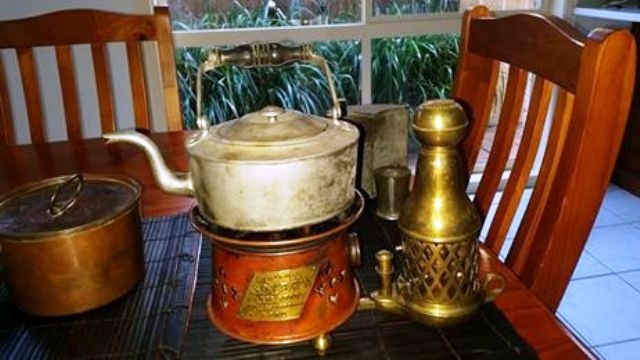 Furthermore, he invented a compact tabletop stove, developed the movable military kitchen, relieved some of the appalling deprivations of British soldiers in the Crimean War, and helped organize soup kitchens during the Irish Potato Famine.
A side note, since Crimea is once again on our radar screens: this three-year conflict introduced frontline  reporting and modern warfare techniques, revolutionized medical care on the battlefield, introduced Florence Nightingale and modern nursing, and, of course, is remembered for the disastrous Charge of the Light Brigade.
The Bare Facts
Alexis Soyer was born into a Huguenot family in Meaux-en-Brie (yes, the home of that wonderful cheese). Perhaps his sense of humanity stemmed from this religious schism within the deeply Catholic nation into which he was born. Alexis, even from the little that is recorded, was clearly of a rebellious mind. His brother Philippe, a successful chef in Paris, got Alexis an apprenticeship there, and this young sibling became the darling chef-caterer of the Parisian in-crowd — only to have it all blown away by a second political revolution in 1830. His ever-resourceful brother had by then become chef for the Duke of Cambridge and once again maneuvered a position in his kitchen for his little brother.
Alexis, clearly ambitious and independent, soon found employment as chef to the Reform Club — entirely in keeping with his temperament. The Reform Club was remarkably progressive. It was obviously only open to men at its inception, but it later became one of the first clubs to offer full membership to women in 1981. Its members proposed radically liberal ideas such as expanded voting rights and curbing the political power of the aristocracy.
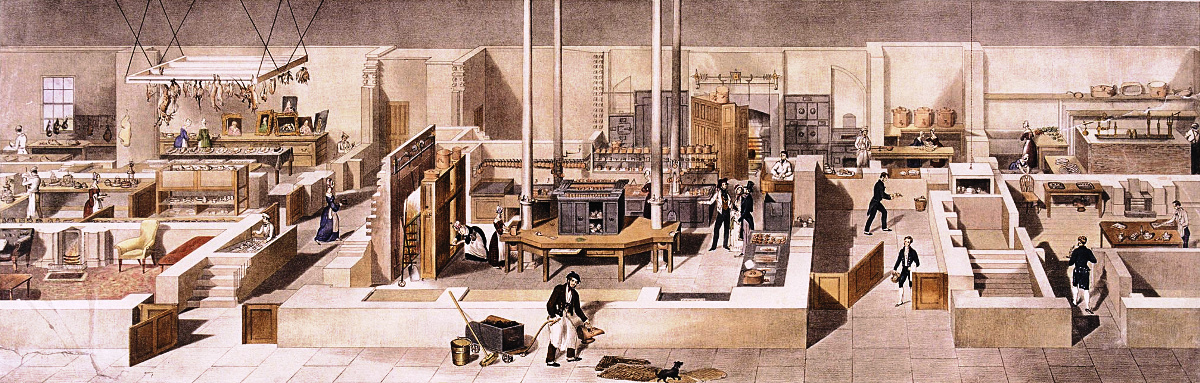
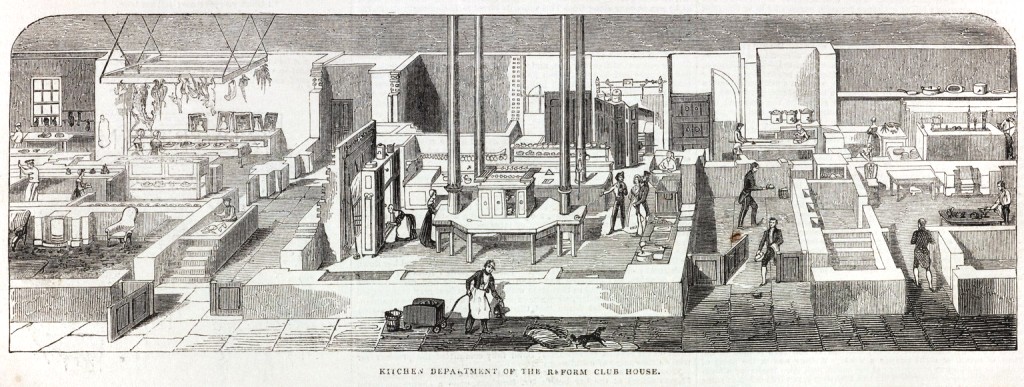
During his tenure at the club, he designed the kitchen with remarkable foresight into modern culinary technology. He introduced coal and gas for cooking, a uniquely irregular twelve-sided steaming table with compartments for quickly needed spices and condiments, cold-water circulating systems, and ice lockers for fish and meat. His kitchen became a tourist attraction for the Reform Club, which organized regular tours of this basement kingdom. He also hired women as cooks and championed their culinary training so they could transition from domestic positions to professional ones.
When the horrors of the Irish Potato Famine became public, the British government requested his expertise in setting up a kitchen to feed a starving population in Dublin. Remarkably, Soyer went to Dublin and designed the first soup kitchens, capable of feeding 1,000 people per hour with his nutrient-packed famine soup recipe. The recipe itself was highly controversial in that it was not solid food, but rather was made with barley water, beef drippings, onions, and other available vegetables. And Soyer, ever theatrical and practical, charged affluent spectators to watch impoverished Irish citizens hurriedly eat their soup with their cutlery chained to the tables. He also wrote a pamphlet of recipes for feeding the destitute in order to raise funds for his soup kitchen — a project he later expanded in London.
And lastly, in regard to the Crimean War, mentioned earlier in this post: Alexis Soyer, informed by the brutally honest frontline dispatches of William Howard Russell, went to two battlefronts at his own expense. Appalled by the lack of organization and shocking sanitary conditions in which the soldiers ate, he created a system of centralized field kitchens for each military division and trained both soldiers and cooks in how to prepare their rations to avoid food poisoning and disease. His military stove, essentially an equipped horse-drawn boiler, could serve 50 men at a fraction of the cost of wood-fired stoves and served as a heater for freezing troops. It remained in service for the British Army through the Falklands War in 1982.
Alexis Soyer himself became quite ill from his time on the Crimean War front and ultimately died from complications of two diseases he had contracted there. His personal life deserves a footnote here. While serving as a chef in Paris in his youth, he was in a relationship with Adelaide Lemain and had a son. He abandoned them when he fled France after the 1830 Revolution. Jean Alexis Lemain never knew who his biological father was until he was 21. He tracked him down in London and was privately acknowledged by his father, who allowed him to adopt his last name and even made him his heir. Alexis had always been highly flamboyant, inventive, and in love with his highly public life. His son, who became a chef and pâtissier, preferred a much more private one.
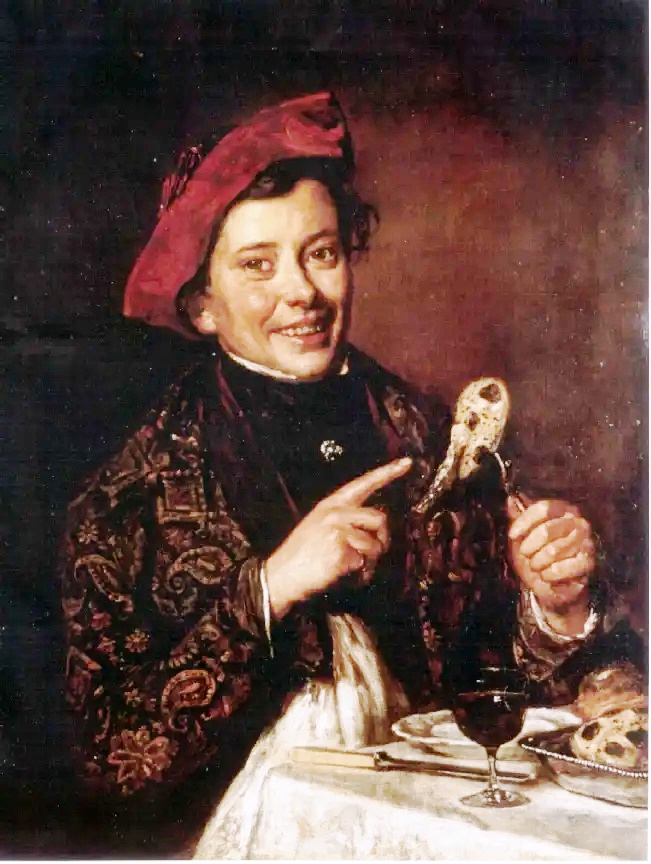
There exist a number of paintings of Alexis Soyer, due primarily to his marriage to the incredibly talented artist Elizabeth Emma Soyer. She, a child prodigy in portraiture, had paintings in exhibitions at the age of 11. In fact, the two met in her stepfather’s studio, where the flamboyant chef was having his portrait painted. Elizabeth was as singular a personality as he was. They fell in love and were married shortly after, and they supported each other passionately — he promoted her with his clients, and she painted him and introduced him to new people of influence. They were, in a sense, a power couple. The marriage tragically ended in her death five years later, while she was pregnant. Alexis Soyer later enjoyed a long affair with the famous ballerina Fanny Cerrito. He publicly celebrated her with culinary creations, and their relationship was only briefly paused by Cerrito’s marriage. In an unlikely move for the highly extroverted Alexis Soyer, the two were secretly married before he died from complications of the illnesses he had suffered during the Crimean War.
It’s ironic that a man so consumed with feeding the hungry and comforting the suffering had so little comfort in his own private life — forced to flee a hard-earned career by a revolution, working tirelessly in famine and war, burying a first wife, and only meeting his only child as a grown man. We have marble busts and major culinary societies and schools named after Escoffier. There are library collections, a culinary medal, and a pastry company (plus a TV series devoted to his life) that have memorialized Carême. Alexis Soyer deserves at least a soup kitchen named after him and a military medal of recognition. I chanced to discover him via a Prue Leith Instagram post — several notches up from obscurity, but far from the recognition he deserves.



Fascinating, Nancy. Thanks for shedding light on a piece of history from the world of food.
This is fascinating . I had never heard of him, and I’ve been cooking and reading about food and famous people in food for just over 50 years. Hopefully he will now get the recognition he rightly deserves.