
A Member of the Family
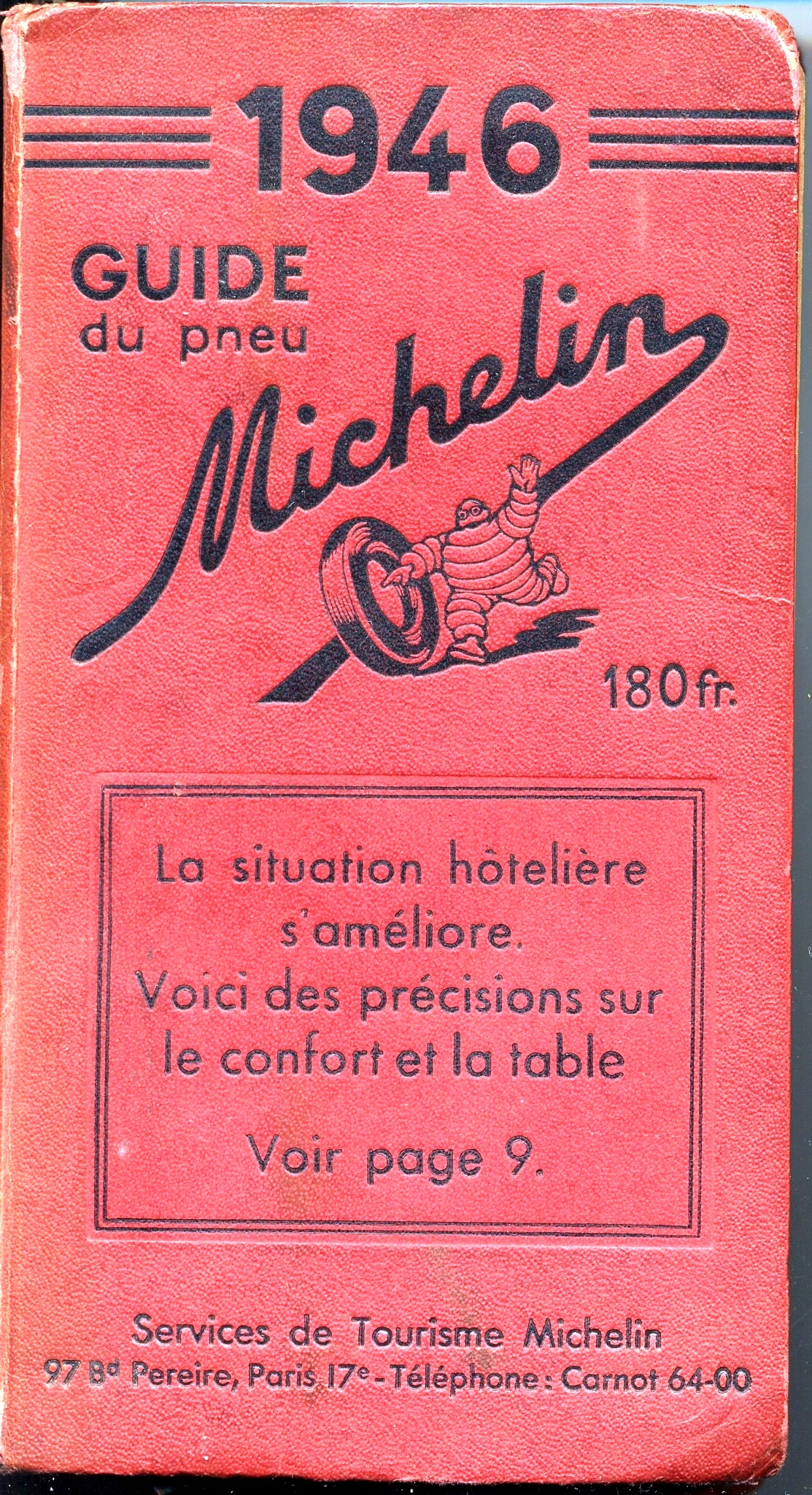 The Michelin Guide has long been like a close family member — always at my father’s side when we lived in Europe, its red spine peeking out of a car door pocket whenever we traveled with our chocolatier friends. (Many KD readers, I know, will remember La Cuisine’s tradition of Panel Chocolates at Christmas.) Carrying a Michelin guide, first in France and later in Italy, was part of our family’s travel tradition. Our daughters took great delight in deciphering its obscure hieroglyphics — and the tiniest print imaginable — to figure out where we’d eat next and, occasionally, where we’d sleep.
We used the guide on a once-in-a-lifetime wedding anniversary trip through France, chasing starred restaurants and hotels. It was glorious: some meals were genuinely vaut le voyage — a term Michelin was famously stingy about — and others were almost caricatures of snooty dining, with overwrought food and stiff service. We enjoyed every bit of it. I can’t imagine having done that trip under the auspices of TripAdvisor, or worse, Yelp.
You could say we were wedded to our Michelin guide. So the news that Michelin is now sleeping with Sysco — so far only in the U.S., though this affair will likely be in test mode elsewhere — landed as both a shock and a disappointment. If you read my earlier post on Sysco, or if you’re familiar with their huge trucks lurching around neighborhood eateries, you’ll understand why I view this alliance with alarm, not just suspicion.
A System of Symbols
Michelin recognition is cash in the bank for any restaurant. Everyone knows the rounded stars — the top number is three, not five — but do you know the other symbols?  The tire-shaped figure licking his lips marks a Bib Gourmand: an eatery that’s friendly and serves good food at moderate prices. We go to plenty of these. Then there are the crossed knives and forks, in two sizes, denoting comfort and, to a degree, the fussiness of the service. The guide has experimented with other marks that come and go — two coins once meant a good deal for the diner’s wallet — alongside symbols for lovely views, terrace dining, counter seating, and hotel-room comfort. And then there was the ill-fated green leaf for sustainability. More on that shortly.
How It Started
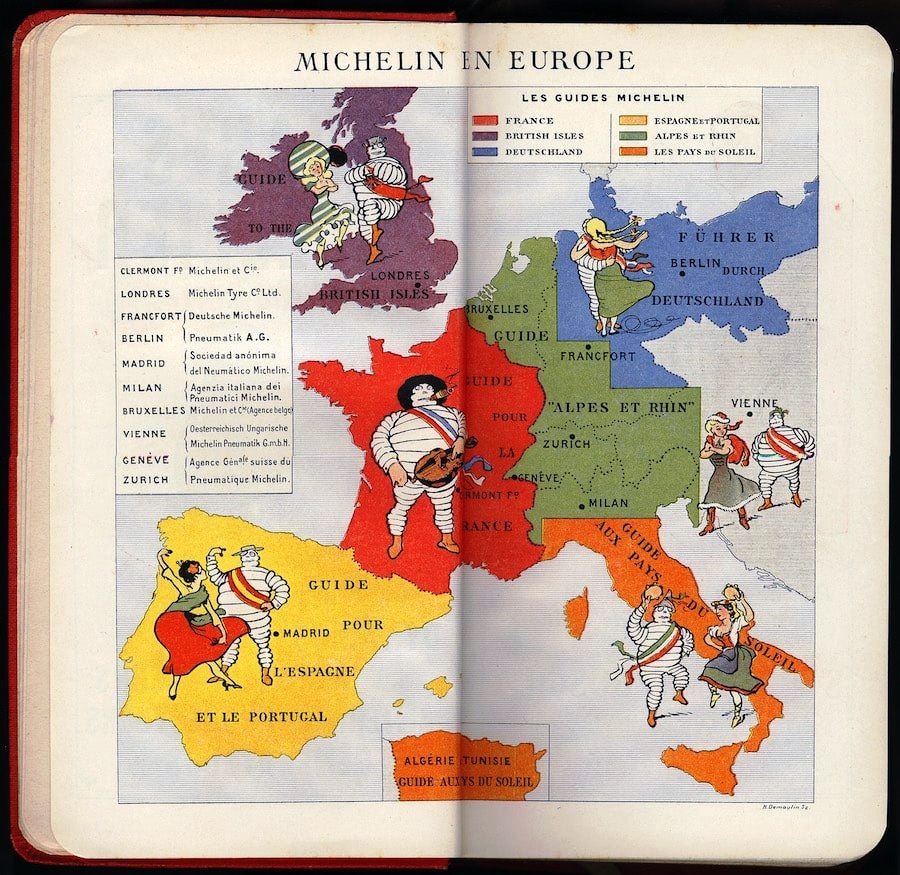 The interesting thing is that the guide began in 1900 as a relatively inexpensive marketing tool for a French tire company. Brothers André and Édouard Michelin had started a tire business and needed a way to sell more tires in a country that could boast only 3,000 newfangled automobiles. Their blue guide was a freebie given to anyone who bought Michelin tires, in the hope that drivers would be enticed to plan road trips around France and thus generate more tire sales. It included instructions on how to change a Michelin tire, plus lists of gas stations and mechanics. In the years that followed, the brothers published similar guides for Belgium, Algeria, Tunisia, and other neighboring countries — all free.
That changed in 1920, when André Michelin spotted a stack of his free guides propping up a workbench 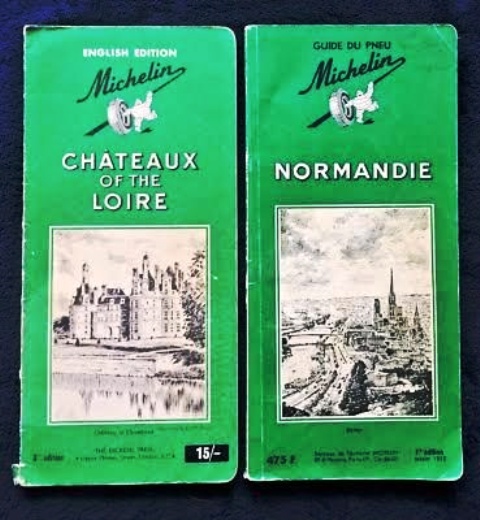 in a garage. He realized a free publication earned no respect. So he stripped out the ads, added hotel listings, and — most consequentially — began hiring “secret diners,” later called inspectors, to review restaurants for the guide. The new, upgraded edition cost 7 francs, about 10 euros in today’s money.
Stars were first awarded in 1926, and in another clever marketing move, the jacket switched from blue to the more visible red in 1931. Michelin also began publishing its remarkable Green Guides — dense with tiny print, elegant line drawings, detailed maps, and condensed histories that would be the envy of AI today. During the final days of World War II, the Allies asked Michelin to reprint its maps, which had gone out of publication under German occupation, because they were considered the most reliable.
Money Talks
It wasn’t until the early years of this century that the Michelin Group began — quite successfully — charging countries like Korea, and even specific resort regions, for the privilege of being inspected, graded, and included in these regional and national guides, which are often available only through their app. Some of these arrangements, like the ones with the Korean and Thai governments, were made public; most today are not and are quietly funded by tourism boards using taxpayer money. Some municipalities and states — Virginia among them, I was glad to see — refused to play along.
One striking sidenote: the Inn at Little Washington, grandfathered in from Michelin’s earlier, self-funded guide to Washington, D.C., is a rare holdout from the current pay-to-play scheme. It earned Michelin’s rare three-star rating — only to be mysteriously reduced to two, right around the time Virginia’s Tourism Board went public about its refusal to pay.
Which Brings Me to Sysco
Sysco is the antithesis of nearly everything Michelin-starred restaurants are known for: good-to-remarkable food, often sourced from a variety of local farms or treasured producers — a carefully raised breed of poultry, say, or a small-batch cheesemaker — alongside thoughtfully curated wine lists, innovative kitchens, and a fidelity to local culinary tradition. Sysco, by contrast, has spent years squeezing out local food producers in favor of factory farms and monocultural suppliers.
One of the first casualties of this new partnership was Michelin’s Green Star. Introduced in 2020 to recognize restaurants working to reduce waste, source food ethically, and run more energy-efficient kitchens, it was an imperfect program from the start — the 300-plus restaurants that earned it largely self-reported, with little real follow-up from Michelin’s own team. Still, it was launched with fanfare and became a new incentive for restaurants to be rewarded for pursuing more sustainable gastronomy. It was quietly retired in 2026, not long after the Sysco-Michelin partnership was sealed.
In its place: “Mindful Voices,” an editorial platform with no standards and no accountability. Sysco’s huge hubs, with thousands of products, plastic packaging, and massive refrigeration and fuel requirements, are the antithesis of the intent of a Michelin star. Meanwhile, Sysco sales reps have reportedly started delivering Michelin plaques to winning restaurants themselves — sometimes after the owner has opened a Sysco account, sometimes not. It’s early days. But the sinister implication is hard to miss. I give this development no stars of any kind.


Comments & Reviews