Improvisation & Inspiration
 While I certainly complained about the misinterpretations of Caesar salad in Italy, I must say that I love the variations of a dish that is definitely an Italian invention: carpaccio. I have made it at home in the US in its 1980s form with beef tenderloin, arugula, and shavings of Parmigiano, but have never attempted the classic or explored beyond its meaty borders. Here, it is
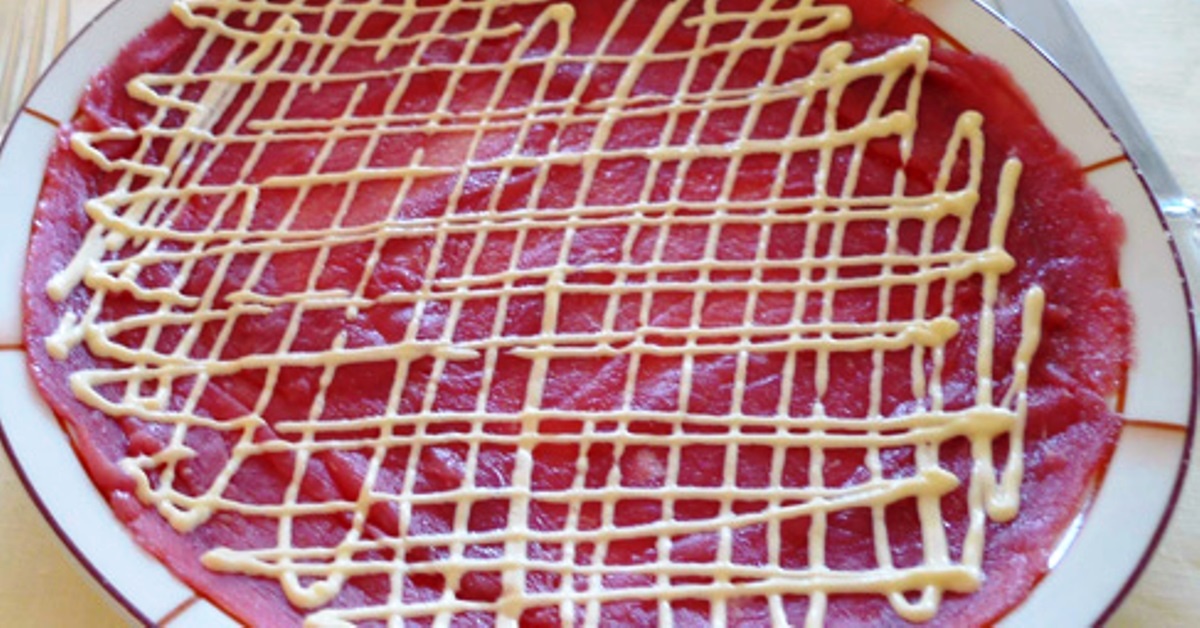
  done with fish, vegetables, and even fruit. The technique is perfect for sultry weather. The original conception featured a round white plate of ultra-thin raw beef slices crisscrossed with random lines of a whitish sauce. Its creator christened it as an homage to Vittore Carpaccio, the 15th-century painter who used vibrant tones of red in his paintings. What is often ignored in describing this intriguing creation is that the design of the sauce was inspired by the paintings of Wassily Kandinsky.
Carpaccio was “invented” by Giuseppe Cipriani—he’s also famous for founding Harry’s Bar in Venice. He created the dish at the request of a client and friend, Amalia Nani Mocenigo, a Venetian countess who had been advised by a doctor to eat raw meat. Giuseppe also invented that refreshing cocktail, the Bellini, which I think also should be medically prescribed. But first, a word about Cipriani himself and the empire he created.
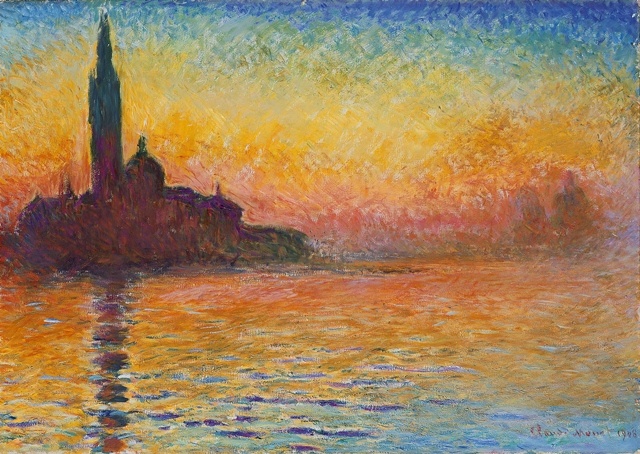 He was born in Verona in 1900 into an impoverished family who later moved to Germany, where his father found a job as a bricklayer. His mother was employed as a cook for his co-workers. The outbreak of World War I forced the family to return to Italy, and Giuseppe was drafted into the military. After the war, Giuseppe honed his skills through employment in hotel restaurants and bars. This was in the age of European grand hotels, and Italy had quite a few. He moved to Venice as a barman and worked at several luxury hotels. The last was the ultra-luxe Hotel Grand Britannia, a favored spot for painters such as Claude Monet (some of his famous paintings were done from his room there) and J.M.W. Turner. It is now the St. Regis and still quite a grand hotel, albeit owned by Marriott.
Early Times
Giuseppe Cipriani ran a friendly operation at the Grand Britannia and was very generous to both fellow employees and patrons. So much so that he lent money to a stranded American, Harry Pickering, who, after a long sojourn in 1927 at the hotel (and a noteworthy drink tab at the bar), was cut off from funds. Giuseppe lent him a substantial part of his savings—10,000 lire—and Harry Pickering returned home, not to be seen again until 1931. He returned to the hotel and gave Giuseppe not only his original loan but also an additional 40,000 lire. The backstory gets delightfully murky. Some accounts say that Harry Pickering’s funds were cut off by his parents, who were shocked at his bibulous habits; another has Harry staying at this luxe hotel in Venice to recover from a “bout of alcoholism” and being left penniless by his angry parents. Others say that Harry was accompanied by an aunt and her lover along with a lapdog. According to this version, the aunt, after an argument with Harry, departed with her lover, but left Pickering with the dog and no funds to pay his hotel bill.
Regardless of the version you prefer (I have fun imagining the last one), Harry Pickering’s repayment 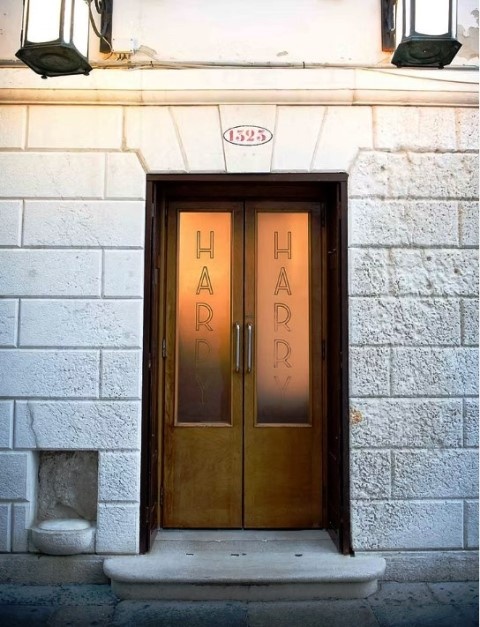 allowed Giuseppe to fulfill a long-held dream of owning his own bar, which he named after his American friend. Giuseppe imbued the small bar (500 square feet in a former rope warehouse) and its employees with a unique format for producing drinks, an unfailing Old World courtesy, and a surprisingly spare interior design. He continued to lend money to patrons who were in need. The bar and its owner attracted a noteworthy clientele from his previous gigs, and his guest book is filled with the autographs of celebrities, painters, and writers. Evelyn Waugh was a habitué and used the bar in his novel “Brideshead Revisited.” Ernest Hemingway, who had a regularly reserved table, wrote much of his novel “Across the River and Into the Trees” there, and also at an inn on the island of Torcello that Giuseppe had bought in 1934. The Locanda Cipriani (which is on the way to one of my favorite restaurants) is currently closed for renovation. Giuseppe was very clever in evading the brutal dictates of the Gestapo in Venice. He famously told some German officers, when asked if he had illegally allowed any Jews into his bar, that he “only saw Italians.”
But back to his two famous contributions to fine dining: first, the Bellini (and I have to digress here that my 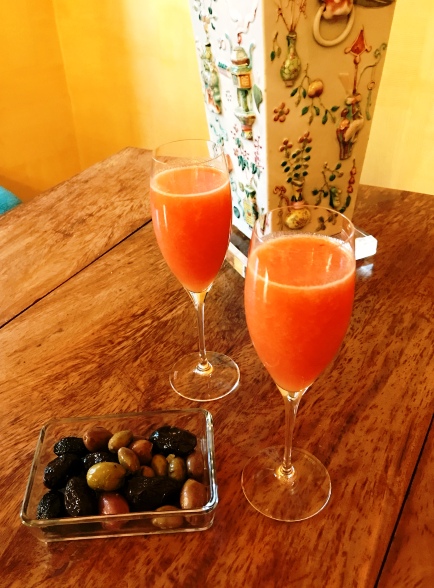 favorite version of his drink is from the River Cafe in London). It was Giuseppe’s celebration of white peaches embellished with Prosecco, which he named after the Venetian painter famous for his use of peach and rose colors in his portraits. It should come as no surprise that this astute and genial man would find inspiration in these paintings, since they were housed in the Accademia museum in his neighborhood. Harry’s Bar has rigorously maintained his formula for both the Bellini and carpaccio.
Inspired by the variations of Giuseppe’s riff on a Piemontese dish, Carne Cruda all’Albese, I delved further into the construction of the Cipriani carpaccio. Here are some guidelines. First, the beef must be fresh and top quality—the center cut of a tenderloin is the one most often used in recipes in the US, but in Italy sirloin is the choice. All fat and silver skin must be removed. While many recipes advise a half-hour freeze to help stiffen the meat, that was not recommended by Giuseppe Cipriani. Using an extremely sharp knife, he sliced off pieces (he may or may not have pounded them flat) and then formed them in a perfect circle on a white plate. You can use plastic wrap placed on top and press to create this full circle. It doesn’t matter that the pieces are irregular in shape; it is the final circular presentation that is important. To this circle he applied a pastry bag filled with his “Universal Sauce” and created crisscrossed lines alla Kandinsky. The sauce (remember, this is post-war Italy in 1950) included Worcestershire sauce to add tang.
You will need:
- About ¾ cup excellent mayonnaise (it really is best to make your own, and it truly is not that hard—see this previous KD post)
- 1 tablespoon fresh lemon juice
- 2–3 tablespoons whole milk
- 2 teaspoons Worcestershire sauce
- Fine sea salt and freshly ground white pepper
Mix the mayonnaise with a small amount of the lemon juice and the Worcestershire sauce. Then add enough of the milk to make the sauce coat the back of a spoon. Check the seasoning and adjust the flavor to suit your taste. You may add a bit more lemon juice or Worcestershire sauce—it is not a rigid recipe. Finish by adding fine sea salt and white pepper. You can store it in the fridge in a disposable pastry bag. Cut a small hole at the tip of the bag to release the sauce in the pattern you choose.
You must assemble this right before you serve it or the beef oxidizes and you will lose the carpaccio red. The plates must be very cold before you arrange the beef pieces. You can enjoy this with an equally cold flute of Franciacorta (the superior Italian answer to French Champagne) or his rosy Bellini. Perhaps a toast to the friendship of Giuseppe and Harry is in order.

I was so into the story about Harry I forgot I was learning about carpaccio.
What a lovely story! I just read Brideshead Revisited for the first time a few weeks ago, so I had to nerd out and look up the specific reference: the narrator and his friend enjoy “hot cheese sandwiches and champagne cocktails at Harry’s bar.” I wonder, is a “hot cheese sandwich” the same thing as our “grilled cheese”?