

Winter is Coming
 I have only watched an occasional episode of Game of Thrones, but this quote has itself become a social media meme and probably inspired a T-shirt or two. The actual quote was coined by author George R. Martin, who wrote A Song of Ice and Fire, on which the HBO series was based.
Asked in an interview what inspired the quote, Martin responded that he had never forgotten his introduction, as a university freshman, to Chicago winters. My daughter and I can bear witness to the same. We visited a college just north of Chicago during an icy blast that froze jewelry to our skin and pierced the multiple layers of clothing we wore. We had to use the hot-air hand dryers in a McDonald’s restroom to thaw our boots and socks.
That said, I still love winter over summer, with the following provisos: functioning heat, a working thermostat, and enough insulated clothing for occasional short walks. Now that we are ensconced in our new apartment, I discovered, in the 106 boxes you have read about somewhat continuously in KD, enough sweaters and outdoor gear to make me an honorary member of the Stark clan.
Unexpected Treasures
I also found one of my favorite cookbooks for this season, Diana Henry’s Roast Figs, Sugar Snow: Food to Warm the Soul. I first wrote about this book in a 2021 post with three recipes, but it was originally published over two decades ago. Diana Henry currently writes a weekly food column for The Telegraph in the UK and develops recipes for BBC Good Food and the grocery chain Waitrose. She also has an Instagram account that features her recipes, recommendations, and a link to sign up for her newsletter. I have returned to her recipes almost weekly since I first stumbled across her cookbook Pure Simple Cooking, published in 2007. It was a steady seller in the shop and one that I used to pack in my suitcase.
Last night, after a day of sorting through coat hangers and packing paper, I roasted a chicken (from this post), baked some Italian potatoes, American-style, with sour cream and chives, and made her deliciously simple recipe for radicchio and Tropea onions from this book. If you shy away from this family of Italian bitter greens, though they are really pinks and reds, this recipe may be a terrific entry point. The recipe itself probably comes from the Veneto region, which is the epicenter of radicchio breeding. You should check out the website for the Culinary Breeding Network in Portland, Oregon, which promotes the production of this marvelous family of vegetables. The founders have written a cookbook, of course, titled Radicchio, so now that I literally trip over a huge selection of radicchio in the markets, I am hoping to order it from Feltrinelli.
The Other Red
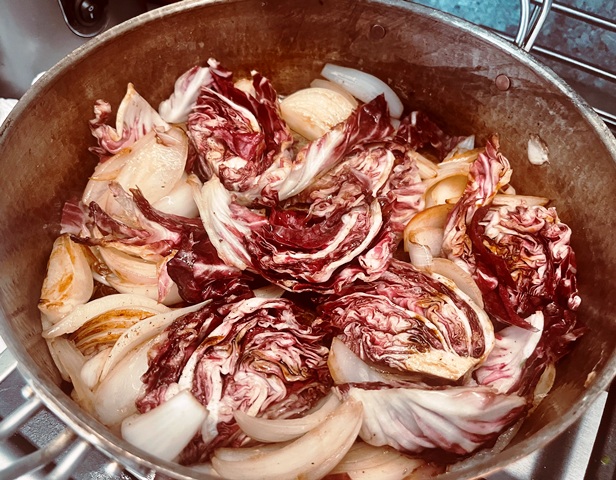 Tropea onions are a DOP-protected variety from Calabria. The closest equivalent I remember purchasing in the US is the Italian Red Torpedo onion. Tropea onions are sweeter and less acidic than the Spanish red onions found in our grocery stores. Failing that, use a white onion; you really need a softer counterpoint to the sautéed Chioggia radicchio, and white onions can be found easily in most US grocery stores. This recipe, which requires no real thought, is great with pork and even with fish. No additional herbs are needed, which in winter would be hard to come by. It is delicious the next day, even at room temperature. Just one of the many treats awaiting you in this treasure of a winter cookbook.
Recipe
Radicchio and Tropea Onions
So simple, so delicious for the dreariest of winter months with any roast and you can halve this recipe or double it easily.
Ingredients
- 2 Chioggia Radicchio
- 4 Tropea Onions
- olive oil
- fine sea salt and freshly ground pepper
- 1/4 cup Balsamic vinegar
- fine sea salt and freshly ground pepper
- additional olive oil for serving
Instructions
- Peel the onions and slice them half lengthwise.
- Cut off the tip of the stem end and just a sliver off the root end.
- Divide each onion half lengthwise into halves or thirds depending on the size of the onions.
- Remove the outer leaves of the head of radicchio if they look dry and tired and cut the head in half.
- Remove only a sliver of the end of the core as it will hold the radicchio slices together.
- Cut each half into quarters.
- In a sauté pan over medium heat, add some olive oil to film the surface.
- Add the onion slices and sauté until edges of the onions are slightly caramelized.
- Lower the heat and cook, stirring occasionally until the onions are softened.
- Add the radicchio slices and raise the heat a little.
- You want the radicchio to caramelize a bit before lowering the heat and allowing the two vegetables to continue to soften.
- Add some balsamic vinegar and at this point I cover the pan, lower the heat and allow the two to cook further.
- In a few minutes, the vinegar will cook into the two vegetables and the heat can be turned off.
- You can briefly reheat right before serving.
And in case you do not share the same love for this unforgiving season, I leave you with a final literary quote from Percy Bysshe Shelley, whose poetry I studied in high school and recently started reading again. He really was a most remarkable poet.
The trumpet of a prophecy! O Wind,
If Winter comes, can Spring be far behind?

Hey Nancy –Is 21 radicchio a misprint? Also, if I’m using white onions what volume cut up do I aim for?
Ciaody Rawles,
Yikes, yes that is a misprint. I fixed it –should be two. And on the sweet white onion, sometimes Spanish white, sometims Vidalia, if they are large (I remember them as being huge) one should suffice. If they are smaller, about the size of small orange, then two would work.